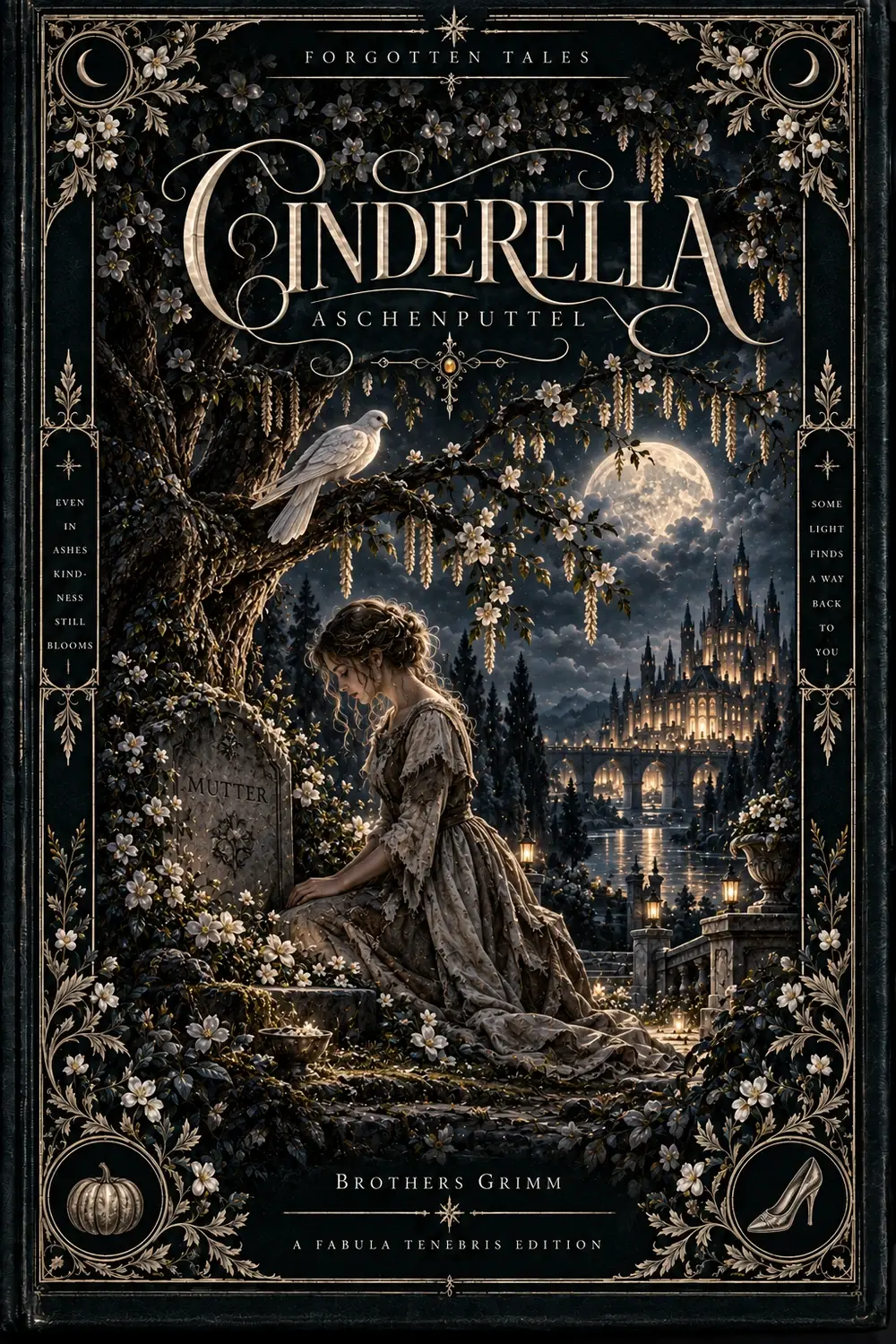
There was once a rich man whose wife fell gravely ill.
When she knew that death was near, she called her only daughter to her bedside.
The child knelt beside her.
Her mother took her hand.
“Dear child,” she whispered, “remain good and kind, and heaven will not abandon you. I will look down upon you, and I will always be near.”
Then she closed her eyes.
And died.
The girl wept bitterly.
Her mother was buried beneath a tree in the garden, and every day the child went there to mourn.
Autumn passed.
Snow covered the grave.
Then spring returned, and the snow withdrew into the earth.
A year after his wife’s death, the rich man married again.
His new wife brought two daughters with her.
They were beautiful.
Their faces were pale and lovely, their clothes fine, their manners graceful whenever strangers were present.
But their hearts were cruel.
From the moment they entered the house, they looked at the man’s daughter with contempt.
“Why should this useless creature live among us?” they said.
“She eats our bread and wears clothes better suited to someone important.”
They took away her fine dresses.
They dressed her in an old grey gown.
They gave her wooden shoes.
And they sent her into the kitchen.
From morning until night she worked.
She carried water.
She lit the fires.
She cooked.
She washed.
She swept.
She scrubbed the floors until her fingers were raw.
The sisters mocked her while she worked.
Sometimes, simply for their amusement, they scattered peas and lentils into the ashes and ordered her to separate them again.
At night, she had no bed.
She slept beside the hearth.
And because she was always covered in dust and ash, they began calling her Aschenputtel.
The little ash girl.
Cinderella.
One day, her father prepared to travel to a fair.
He asked the two stepsisters what gifts they wished him to bring home.
“Beautiful dresses,” said the first.
“Pearls and jewels,” said the second.
Then he turned to Cinderella.
“And you, child? What would you like?”
She thought for a moment.
“The first branch that brushes against your hat on your journey home.”
Her father found the request strange, but he agreed.
At the fair he bought dresses, pearls, and jewels.
And on his return, as he rode beneath a hazel tree, a branch brushed against his hat.
He broke it off.
When he reached home, the sisters seized their gifts with delight.
Cinderella took the little hazel branch.
She carried it to her mother’s grave.
There she planted it in the earth.
Then she knelt beside it and wept.
Her tears fell upon the soil.
She returned the next day.
And the next.
And the next.
The branch took root.
It grew.
In time, it became a beautiful tree.
Cinderella visited it three times every day.
She prayed beneath its branches.
And a small white bird began to appear there.
Whenever Cinderella spoke a true wish beneath the tree, the bird seemed somehow to hear her.
And sometimes, what she wished for would fall gently from the branches above.
Years passed.
Then one day the king announced a great festival.
It would last for three days.
Every beautiful young woman in the kingdom was invited, so that the prince might choose a bride.
The two stepsisters nearly screamed with excitement.
They ordered Cinderella to comb their hair.
To polish their shoes.
To tighten their dresses.
To fasten their ribbons.
All day they spoke of nothing but the palace.
The music.
The prince.
The jewels.
Cinderella listened quietly.
At last she said:
“I would like to go too.”
The sisters stared at her.
Then laughed.
“You?”
“You have no dress.”
“You have no shoes.”
“You smell of smoke.”
The stepmother entered and looked Cinderella up and down.
“If you truly wish to go,” she said, “then perhaps you may earn it.”
She took a bowl of lentils and threw them into the ashes.
“Pick every good lentil from the ash within two hours, and we shall see.”
Then she left.
Cinderella looked at the dark hearth.
Hundreds of lentils lay scattered through the soot.
She opened the kitchen window.
“Gentle birds beneath the sky,
come and help me.”
Soon two white doves flew inside.
Then more birds followed.
Small birds.
Grey birds.
Brown birds.
Birds from the garden and the trees.
They hopped into the ashes and began to work.
The good lentils went into the bowl.
The spoiled ones were eaten.
Before an hour had passed, the task was finished.
Cinderella carried the bowl to her stepmother.
But the woman merely frowned.
“No.”
“You have no clothes fit for a festival. You would embarrass us.”
Cinderella begged again.
The stepmother took two bowls of lentils and threw them into the ashes.
“If you can separate these within one hour, then perhaps.”
Again the birds came.
Again they helped her.
And again Cinderella finished before the appointed time.
But the stepmother had never intended to keep her promise.
“No,” she said.
“You cannot dance.”
“You have nothing to wear.”
“You are not coming.”
Then she left with her daughters.
The house became quiet.
Cinderella stood alone beside the dying fire.
For a moment, she said nothing.
Then she went outside.
Across the garden.
To the hazel tree above her mother’s grave.
She looked up into its branches.
“Little tree,
shake and quiver.
Let silver and gold
fall down upon me.”
The white bird appeared.
Something rustled above.
And from the branches fell a beautiful dress.
Silver and gold shimmered across the fabric.
Beside it fell a pair of delicate slippers.
Cinderella dressed beneath the tree.
Then she went to the palace.
When she entered the festival, everyone turned to look at her.
No one recognized the ash-covered servant girl.
Not her stepmother.
Not her sisters.
They thought she must be a foreign princess.
The prince crossed the hall immediately.
He offered her his hand.
And from that moment onward, he danced with no one else.
Whenever another man approached her, the prince said:
“She is my partner.”
Cinderella danced until evening.
Then she knew she must leave.
“I should go home.”
“I will accompany you,” said the prince.
But she slipped away.
He followed.
She ran through the darkness, reached her father’s property, and disappeared into a pigeon house.
The prince waited outside.
Her father was summoned.
When they opened the little structure, no one was inside.
Cinderella had already escaped through the other side.
She returned to the hazel tree.
The beautiful dress vanished from her.
The old grey gown returned.
When the others came home, she was sitting quietly among the ashes.
The next day, the festival continued.
Once again Cinderella waited until her family had gone.
Then she stood beneath the hazel tree.
“Little tree,
shake and quiver.
Let silver and gold
fall down upon me.”
A second dress fell from its branches.
It was even more beautiful than the first.
Cinderella returned to the palace.
Again, the prince danced only with her.
Again, everyone wondered who she could be.
And again, when evening came, Cinderella escaped.
This time the prince followed her more closely.
She ran into the garden behind her father’s house and climbed a pear tree.
The prince searched everywhere.
Her father came outside.
“Could this mysterious maiden somehow be Cinderella?” he wondered.
He took an axe and cut down the tree.
But there was no girl among its branches.
Cinderella had already slipped away.
When the family entered the house, she sat beside the ashes once more.
On the third day, Cinderella returned to her mother’s grave.
“Little tree,
shake and quiver.
Let silver and gold
fall down upon me.”
This time the dress that fell was more magnificent than anything she had worn before.
The slippers were golden.
At the palace, people stared in silence.
The prince took Cinderella’s hand.
And all evening he refused to release it.
But he had learned from the previous nights.
Before the festival began, he had ordered the palace staircase covered with pitch.
When Cinderella finally fled, one of her golden slippers became trapped on the steps.
She ran on without it.
The prince picked it up.
Small.
Delicate.
Golden.
The next morning he carried the slipper throughout the kingdom.
“The woman whose foot fits this shoe,” he declared, “shall become my wife.”
At last he arrived at Cinderella’s house.
The eldest stepsister was delighted.
She took the golden slipper into her room.
But her foot was too large.
Her toes would not fit.
Her mother watched her struggle.
Then she brought her a knife.
“Cut off your toes.”
The girl stared at her.
“When you are queen, you will have no need to walk.”
So the sister took the knife.
And cut off her toes.
She forced her bleeding foot into the golden slipper.
Then she went to the prince.
He looked at the shoe.
It fit.
So he lifted her onto his horse and rode away.
They passed the hazel tree beside the grave.
Two white doves sat among its branches.
They called:
“Turn and look.
Turn and see.
Blood is flowing from the shoe.
The slipper is too small.
This is not the true bride.”
The prince looked down.
Blood stained the golden shoe.
He turned his horse around.
He brought the woman back.
“This is not the one.”
Then the second stepsister came forward.
She tried the slipper.
Her toes fit.
But her heel was too large.
Again the stepmother brought the knife.
“Cut away your heel.”
The girl hesitated.
“When you are queen, you will have no need to walk.”
So she cut away part of her heel.
Blood filled the slipper.
But the shoe fit.
The prince took her with him.
Again they passed the grave.
Again the doves called:
“Turn and look.
Turn and see.
Blood is flowing from the shoe.
The slipper is too small.
This is not the true bride.”
The prince looked down.
Again he saw blood.
Again he returned.
“Have you no other daughter?”
The father hesitated.
“No.”
Then he remembered.
“There is only a little one left by my first wife. But she is dirty. She sits among the ashes. She could not possibly be the woman you seek.”
The prince answered:
“Bring her to me.”
The stepmother protested.
“She cannot be seen like this.”
But the prince insisted.
Cinderella went to wash herself.
She cleaned the ash from her face and hands.
Then she entered the room.
The prince handed her the golden slipper.
She sat down.
Removed her wooden shoe.
And slipped her foot inside.
It fit perfectly.
She stood.
The prince looked into her face.
For the first time, there was no palace light.
No silver dress.
No gold.
No music.
Only the ash girl standing before him.
And he recognized her.
“This is the true bride.”
The stepmother turned pale.
The sisters stared in horror.
The prince lifted Cinderella onto his horse.
They rode away.
As they passed her mother’s grave, the two white doves flew from the hazel tree.
One settled upon Cinderella’s right shoulder.
The other upon her left.
And they went with her.
When the wedding day came, the two stepsisters attended.
They hoped to share in Cinderella’s good fortune.
As the procession entered the church, the elder sister walked beside Cinderella.
One of the white doves flew down.
And pecked out one of her eyes.
The younger sister followed.
The second dove descended.
And took one of hers.
Still, the sisters remained.
Still hoping for favor.
Still hoping to profit from the woman they had once tormented.
When the wedding procession left the church, the birds returned.
The elder sister lost her remaining eye.
Then the younger lost hers.
And so the two sisters were left blind for the rest of their lives.
Not because they had been ugly.
Not because they had failed to marry a prince.
But for their cruelty.
For their deceit.
And for everything they had done when they believed no punishment would ever come.
Cinderella left the church beside her husband.
Behind her lay the ashes.
Ahead stood the palace.
But somewhere far from both,
beneath a hazel tree,
her mother’s grave remained covered in leaves.
And two small impressions rested upon the branches where the white birds had once waited.
The end.
About this edition
Aschenputtel is the Brothers Grimm version of the Cinderella tale and appears as KHM 21 in Kinder- und Hausmärchen. The Grimms’ collection first appeared in 1812 and was revised across several later editions. The tale belongs to the internationally widespread ATU 510A, “Cinderella” / persecuted heroine tradition.
This version differs substantially from Charles Perrault’s famous Cendrillon. There is no fairy godmother, no pumpkin carriage, and no glass slipper. Cinderella’s supernatural assistance is connected instead to her dead mother, the hazel tree growing upon her grave, and the birds that answer her wishes. The festival lasts three days, and the lost slipper is golden.
The tale also preserves the elements that later adaptations often remove. One stepsister cuts off her toes and another cuts away part of her heel so that the golden slipper will fit. Their deception is exposed by the blood in the shoe and by the birds at Cinderella’s mother’s grave. At the wedding, the birds ultimately peck out both sisters’ eyes.
Primary reference: Jacob and Wilhelm Grimm, “Aschenputtel,” KHM 21, from Kinder- und Hausmärchen.
Public-domain reference: historical Grimm editions and public-domain English translations preserved through Project Gutenberg and related archival collections. Project Gutenberg specifically preserves older works whose U.S. copyrights have expired.
This Fabula Tenebris edition is an original English retelling based on the historical Grimm narrative rather than a reproduction of a modern translation.
The historical tale & its ending
Which version of Cinderella is this?
This is a modern English retelling of Aschenputtel, KHM 21 in the Brothers Grimm’s collection. “Original Cinderella” does not identify one universal text: this page follows the Grimm tradition, not Charles Perrault’s Cendrillon, and is not a transcription of the Grimms’ first edition.
What happens in Grimm’s darker Cinderella ending?
The stepsisters injure their feet to fit the golden slipper, but the blood exposes them. Birds later blind them at the wedding. These episodes belong to the Grimm narrative followed here; the historical comparison text is linked below.
Historical editions & further reading
These historical editions are offered for comparison and further reading. The supplied Fabula Tenebris edition above is not presented as a verbatim transcription of these sources.
Cinderella — Grimm’s Household Tales, Volume 1 — Margaret Hunt’s historical English translation for comparison; not the wording of this retelling.