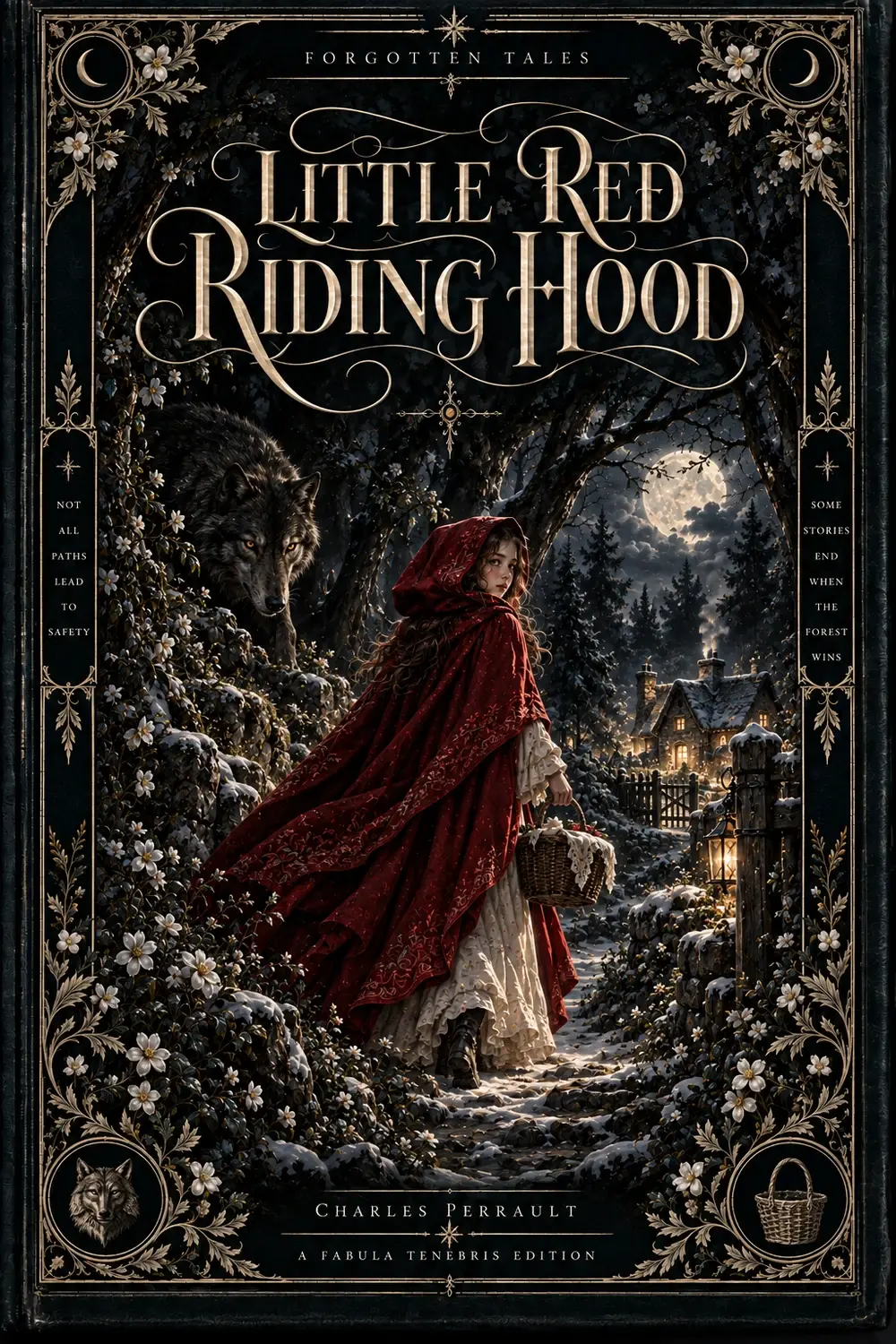
Little Red Riding Hood
France · 1697 · Literary Fairy Tale
A Fabula Tenebris Edition
5 minute read
Once, in a village beside a great wood, there lived a little girl so lovely and bright that her mother adored her beyond measure, and her grandmother perhaps even more.
Her grandmother had made for her a small hood of deep red cloth.
It suited the child so perfectly that before long everyone had forgotten to call her anything else.
She was simply Little Red Riding Hood.
One morning, her mother baked cakes, and while they were still warm she wrapped one carefully and placed it inside a basket beside a little pot of butter.
“Your grandmother has been unwell,” she said. “Go and see how she fares. Take her this cake and butter, and give her my love.”
Her grandmother lived beyond the wood, in another village.
And so Little Red Riding Hood set out alone.
The forest was old and beautiful.
Sunlight broke through the leaves in narrow golden shafts. Ferns trembled beneath the trees. Birds called to one another from branches so high that they seemed to belong to another world.
And somewhere among those trees walked a wolf.
He saw the girl before she saw him.
He was hungry.
Indeed, he had eaten nothing for several days, and the sight of the little red figure moving through the green awakened in him an immediate desire to devour her.
But there were woodcutters working nearby.
Their axes rang through the forest.
So the wolf did not attack.
Instead, he smiled.
“Good morning, little one.”
Little Red Riding Hood stopped.
“Good morning, sir.”
“And where might you be going so early?”
She had never been taught that the most dangerous creatures do not always show their teeth.
“I am going to see my grandmother.”
“How thoughtful. And what have you there?”
“A cake and a little pot of butter. My mother has sent them because Grandmother is ill.”
The wolf lowered his head pleasantly.
“Does your grandmother live far away?”
“Oh, yes. Beyond the mill you can see in the distance. Her house is the first one in the village beyond it.”
Now the wolf knew everything he needed.
“I believe I shall visit her as well,” he said. “Why don't we make a little game of it? You take that path, and I shall take this one. Let us see which of us arrives first.”
Little Red Riding Hood thought this sounded delightful.
So they parted.
The wolf chose the shortest road and ran as quickly as his legs could carry him.
The girl chose the longer one.
And because the morning was beautiful, she did not hurry.
She stopped beneath hazel trees to gather nuts.
She chased butterflies between shafts of sunlight.
Whenever she found some particularly pretty little flower, she picked it for her grandmother, until she had gathered a bouquet almost too large for her hands.
Meanwhile, the wolf reached the old woman's house.
He knocked.
Knock. Knock.
“Who is there?” called a weak voice from inside.
The wolf softened his own voice as best he could.
“It is your granddaughter, Little Red Riding Hood. Mother has sent you a cake and a little pot of butter.”
Grandmother was lying in bed, still ill.
“Lift the latch,” she called. “The door will open.”
The wolf lifted it.
The door opened.
And before the old woman could cry out, he crossed the room and fell upon her.
He devoured her quickly.
Then he closed the door.
He drew the curtains.
He climbed into Grandmother's bed, pulled the blankets around himself, and waited.
At last, there came another knock.
Knock. Knock.
“Who is there?”
Little Red Riding Hood froze.
Something about the voice frightened her.
It was deeper than she remembered.
Rougher.
But then she thought of her grandmother's illness.
Perhaps she had caught a cold.
“It is Little Red Riding Hood,” she answered. “I have brought you a cake and a little pot of butter from Mother.”
The voice from the bed became softer.
“Lift the latch, my dear. The door will open.”
She did.
Inside, the cottage seemed unusually dark.
“Put the basket down,” said Grandmother's voice, “and come closer.”
Little Red Riding Hood approached the bed.
The curtains were partly drawn, and beneath the blankets she could make out a strange shape.
Her grandmother seemed very different that morning.
Still, the girl came nearer.
“Grandmother,” she said, “what great arms you have.”
“All the better to embrace you with, my child.”
She looked again.
“Grandmother, what great legs you have.”
“All the better to run with, my child.”
The girl hesitated.
“And what great ears you have.”
“All the better to hear you with.”
She leaned closer into the darkness.
“What great eyes you have.”
“All the better to see you with.”
Now she was very near.
Near enough to see the mouth beneath the blankets.
Her voice became small.
“Grandmother...
what great teeth you have.”
The wolf smiled.
“All the better—
to eat you with.”
He sprang from the bed.
And the wolf devoured Little Red Riding Hood.
There was no woodcutter at the door.
No hunter passing beneath the window.
No blade opened the wolf's belly.
No one arrived in time.
The forest remained exactly as it had been before.
The trees moved softly in the wind.
The butterflies wandered among the flowers.
And on the table inside the little cottage sat a cake and a small pot of butter,
untouched.
MORAL
Not every wolf comes snarling from the darkness.
Some speak gently.
Some bow politely.
Some are charming and pleasant, and seem far too civilized to possess teeth at all.
And these are often the wolves one should fear most.
For the creature that looks like a monster is easily recognized.
The more dangerous wolf is the one who convinces you that he is not one.
The end.
About this edition
Charles Perrault published “Le Petit Chaperon rouge” in Paris in 1697 as part of Histoires ou Contes du temps passé, avec des moralités. Unlike the later version popularized by the Brothers Grimm, Perrault's tale contains no rescue: the wolf devours both Grandmother and Little Red Riding Hood. (Wikisource)
Perrault then makes the metaphor explicit in his original moral. His “wolves” include men who appear tame, agreeable, courteous, and gentle while pursuing young women — whom he describes as the most dangerous wolves of all. (Wikisource)
Primary reference: Charles Perrault, Histoires ou Contes du temps passé, Claude Barbin, Paris, 1697, pp. 47–56. (Wikisource)
The historical tale & its ending
Does Little Red Riding Hood die in Perrault’s version?
Yes. The wolf devours both her grandmother and Little Red Riding Hood, and nobody rescues them. This is the ending of Perrault’s 1697 literary tale, not the familiar rescue ending associated with the Brothers Grimm.
What is the moral of the original Perrault tale?
Perrault’s moral turns the wolf into a warning about human predators, particularly those who seem courteous and gentle. This edition retains a retelling of that moral after the narrative. It presents one historical literary version, not the first telling of every Red Riding Hood tradition.
Historical editions & further reading
These historical editions are offered for comparison and further reading. The supplied Fabula Tenebris edition above is not presented as a verbatim transcription of these sources.
Little Red Riding Hood — Old-time Stories — A historical English translation of Perrault’s tale for comparison.