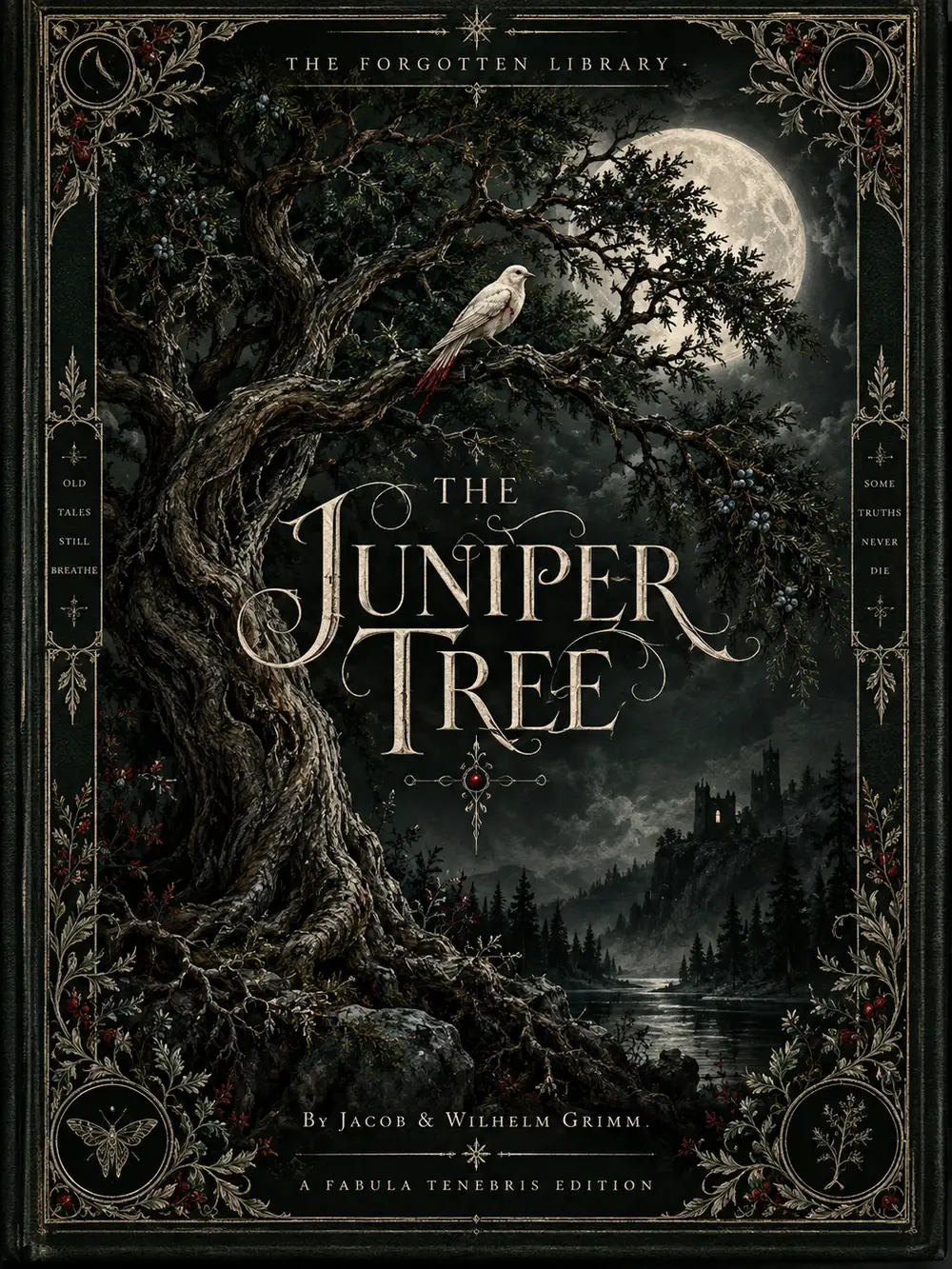
The Juniper Tree
Germany · KHM 47 · ATU 720
A Fabula Tenebris Edition
12 minute read
Long ago—so long ago that people said it must have been two thousand years—there lived a wealthy man and his beautiful wife.
They loved one another dearly, but there was one sorrow in their house: they had no child.
The woman prayed for one by day and by night, and still the rooms remained silent.
In the courtyard before their house stood an old juniper tree.
One winter morning, the woman stood beneath it peeling an apple. Snow covered the ground, white and untouched. As she drew the knife through the peel, its edge slipped across her finger.
A drop of blood fell into the snow.
The woman looked at the red upon the white and sighed.
“If only I had a child as red as blood and as white as snow.”
No sooner had she spoken than a strange peace came over her.
She felt, without knowing how, that her wish had been heard.
The months began to pass.
After the first, the snow melted.
After the second, the earth grew green.
After the third, flowers pushed their heads from the soil.
After the fourth, the branches of the forest thickened and intertwined, and birds filled the woods with song.
When the fifth month came, the woman stood once more beneath the juniper tree. Its scent was so sweet that her heart leapt within her, and she sank to her knees with joy.
In the sixth month, the fruit upon the trees grew full.
In the seventh, she reached for the juniper berries and ate them greedily.
Then sadness came over her.
When the eighth month had passed, she called her husband to her.
“If I die,” she said, “bury me beneath the juniper tree.”
Having said this, she became peaceful again.
And when the ninth month ended, she gave birth to a little boy.
His skin was white as snow.
His cheeks were red as blood.
The instant she saw him, her happiness was so great that her heart could bear no more.
She died.
Her husband buried her beneath the juniper tree.
For a long time he wept bitterly. Then, little by little, grief became something he could carry.
Years passed.
At last he married another woman.
With his second wife he had a daughter, whom they called Marlinchen.
But the son remained the child of his first wife.
And as the boy grew, so too did something dark within his stepmother.
Whenever she looked at her daughter, she thought:
Everything should belong to her.
Then she would look at the boy and remember that he stood before Marlinchen in inheritance.
The thought took root.
It returned each morning.
It whispered to her at night.
And the more she listened, the less she could bear the sight of him.
She began to treat him harshly.
She scolded him without cause.
She struck him.
She drove him from one corner of the house to another until the boy scarcely knew where he might stand without angering her.
He became frightened whenever she entered the room.
Yet Marlinchen loved her brother.
One afternoon, the woman went upstairs to a chamber where she kept apples in a great wooden chest.
Its lid was heavy, and its lock was made of iron.
Marlinchen followed her.
“Mother,” said the girl, “may I have an apple?”
“Yes, my child.”
The woman opened the chest and gave her a bright red apple.
“Will you give one to my brother too?”
The woman looked at her daughter.
For a moment her face changed.
Then she said, “Yes. When he comes home.”
Marlinchen went away with her apple.
The woman remained beside the open chest.
A terrible thought entered her mind.
And instead of driving it away, she welcomed it.
Soon afterward the boy came home.
“Mother,” he said, “may I have an apple?”
Her voice was unusually gentle.
“Of course, my son. Come and choose one.”
The boy hesitated.
Her kindness frightened him more than her anger.
Still, he approached the chest and bent down to look at the apples inside.
“Reach farther,” said the woman. “The finest ones are at the bottom.”
The boy leaned into the chest.
Then the woman seized the heavy lid and slammed it shut.
The iron edge came down across his neck.
His head fell among the apples.
For a moment the woman stood completely still.
Then terror seized her.
“What have I done?”
She paced the room, trembling.
But fear quickly became calculation.
She lifted the boy's body, carried it to a chair beside the door, and placed his head back upon his neck.
Then she tied a white handkerchief around it so carefully that the wound could not be seen.
She placed an apple in his hands.
When she was finished, he looked almost as though he were merely sitting quietly.
Marlinchen came into the room.
Her brother did not move.
“Brother?”
No answer.
She looked at her mother.
“Why is he so pale?”
“Go and ask him whether he will give you his apple.”
Marlinchen approached him.
“Brother, may I have your apple?”
He said nothing.
Her mother called from behind her.
“If he will not answer you, strike him on the ear.”
Marlinchen did not want to.
But her mother insisted.
So the girl raised her hand and struck her brother lightly.
His head fell to the floor.
Marlinchen screamed.
She ran to her mother sobbing.
“Mother! I knocked my brother's head off!”
The woman gathered her into her arms.
“Hush. Hush. No one must know. What is done cannot be undone.”
Marlinchen trembled so badly she could hardly stand.
“We shall cook him,” said her mother, “and say nothing about it.”
The woman took the boy's body away, cut it into pieces, and prepared it in a stew.
Marlinchen could not stop crying.
Her tears fell into the pot.
She cried so much that no salt was needed.
That evening the father returned home and sat down to eat.
“Where is my son?” he asked.
The woman brought him the stew.
“He has gone away to visit his mother's relatives,” she replied. “He says he will be gone for some time.”
The father frowned.
“He left without saying goodbye?”
“He was impatient to go.”
The father took a spoonful of the stew.
Then another.
“This is very good.”
Marlinchen sat silently nearby.
She could not eat.
The father continued.
“Give me more.”
His wife gave him another helping.
Then another.
The more he ate, the more he wanted.
“No one else shall have any,” he said. “Somehow it feels as if all of this belongs to me.”
And he ate until nothing remained but bones.
Whenever he tossed one beneath the table, Marlinchen secretly gathered it.
When the meal was over, she carried all the bones upstairs.
She took her finest silk handkerchief and wrapped them inside it.
Then she went outside.
She carried the little bundle to the juniper tree.
The moment she laid it beneath the branches, she felt strangely lighter.
The tree began to move.
There was no wind.
Its branches drew together and separated again like hands.
A mist rose around the trunk.
Within it burned something like fire.
Marlinchen stepped backward.
The mist folded into itself.
The flame vanished.
And from the juniper tree flew a magnificent bird.
Its feathers shone red and green.
Gold seemed to glow around its neck.
Its eyes were bright as stars.
The bird rose into the air, singing so beautifully that Marlinchen forgot for a moment that she had been crying.
Then it flew away.
The bird came first to the house of a goldsmith.
It perched upon the roof and sang:
My mother took my life away,
My father ate me at his board,
My sister, little Marlinchen,
Gathered every bone of mine,
Wrapped them softly in her silk,
And laid them beneath the juniper tree.
Kywitt, kywitt—
What a beautiful bird am I.
The goldsmith was working at his bench, making a golden chain.
When he heard the song, he stopped.
He hurried into the street so quickly that one slipper fell from his foot, but he did not bother to retrieve it. He stood beneath the roof with one shoe on, still holding his pincers in one hand and the golden chain in the other.
“Bird!” he called. “What a beautiful song. Sing it once more.”
The bird tilted its head.
“I do not sing twice for nothing.”
“What would you have?”
“The golden chain.”
The goldsmith looked at the chain in his hand.
Then he smiled and held it up.
“Take it.”
The bird swept down, caught the chain in its right claw, returned to the roof, and sang the song again.
Then it flew away.
Soon it reached the house of a shoemaker.
The bird landed above the door and began its song.
The shoemaker rushed outside.
His wife came after him.
Then his children.
Then his apprentices.
Soon everyone stood in the street staring upward at the marvelous bird with its red and green feathers, golden neck, and shining eyes.
“Sing it again!” said the shoemaker.
“I do not sing twice for nothing.”
“What do you want?”
“A pair of red shoes.”
The shoemaker sent his wife upstairs.
She returned carrying a fine pair.
The bird seized them in its left claw and sang again.
Then it flew onward, the golden chain in one claw and the red shoes in the other.
At last it came to a mill.
The mill wheel turned:
Klipp-klapp. Klipp-klapp. Klipp-klapp.
Twenty millers were outside cutting a great stone.
The bird perched in a lime tree and sang.
At the first line, one man stopped working.
At the second, two more lowered their tools.
As the song continued, more and more of them became still.
By its final words, not one hammer was moving.
“Bird,” said one of the millers, “sing that again.”
“I do not sing twice for nothing.”
“What would you have?”
The bird looked toward the enormous millstone.
“That.”
The millers laughed.
But one said, “If the others agree, let him have it.”
And because they wanted to hear the song again, all twenty agreed.
Together they raised the massive stone with a beam.
The bird descended and slipped its neck through the hole at the center, wearing the millstone as though it were nothing more than a collar.
Then it sang once more.
When the song ended, the bird spread its wings.
The golden chain hung from its right claw.
The red shoes from its left.
The millstone rested around its neck.
And carrying all three, it flew toward home.
Inside the house, the father, the stepmother, and Marlinchen were sitting at the table.
Suddenly the father smiled.
“How strange,” he said. “I feel so happy today.”
His wife shuddered.
“I do not. I feel as though a storm is coming.”
Marlinchen sat quietly and wept.
Then the bird landed upon the juniper tree.
The father looked toward the window.
“The sun seems so warm.”
His wife began to tremble.
“My teeth are chattering.”
“I feel,” said the father, “as though an old friend is coming home.”
Then the bird began to sing.
My mother took my life away—
The woman covered her ears.
She shut her eyes.
Still she heard the song roaring inside her head like thunder.
My father ate me at his board—
“What a wonderful bird!” cried the father. “Listen to him! And what a sweet smell there is outside—almost like cinnamon.”
My sister, little Marlinchen—
Marlinchen buried her face against her knees and wept.
“I must see this bird,” said the father.
His wife caught his arm.
“Do not go outside! The whole house feels as though it is burning!”
But he pulled away and stepped into the courtyard.
The bird finished its song.
Then it opened its right claw.
The golden chain fell from above and settled perfectly around the father's neck.
He touched it in astonishment.
“What a magnificent bird!”
He returned inside.
“Look what he has given me!”
His wife stared at the chain.
Her face became white.
Outside, the bird began again.
My mother took my life away—
The woman fell to the floor.
My father ate me at his board—
She pressed her hands against her ears.
My sister, little Marlinchen—
Marlinchen lifted her head.
“I will go too,” she said softly. “Perhaps the bird has something for me.”
She stepped outside.
The bird sang:
Gathered every bone of mine,
Wrapped them softly in her silk—
The red shoes fell from its left claw and landed before her.
Marlinchen picked them up.
By the time the bird finished its song, the sadness that had crushed her heart seemed to lift.
She put on the shoes and danced back into the house.
“Mother! I went outside so unhappy, but now my heart feels light. Look—the beautiful bird gave me these red shoes!”
The woman sprang to her feet.
Her hair stood from her head as though each strand had caught fire.
“No,” she whispered.
Then louder:
“No. I cannot endure it. It feels as though the world itself is ending.”
She stumbled toward the door.
“I will go outside too. Perhaps then my heart will grow lighter.”
She crossed the threshold.
The bird released the millstone.
It fell.
There was a terrible crash.
The father and Marlinchen ran into the courtyard.
Smoke rose from the ground.
Flames flickered within it.
For a moment they could see nothing.
Then the smoke parted.
The bird was gone.
The millstone was gone.
And standing beneath the juniper tree was the little boy.
Alive.
He took his father's hand.
Then Marlinchen's.
And the three of them stood together beneath the branches.
Their sorrow had passed.
Their house was theirs again.
So they went inside.
And together, they sat down at the table.
The end.
About this edition
The Juniper Tree was collected by Jacob and Wilhelm Grimm and appears as tale KHM 47 in their Kinder- und Hausmärchen. This Fabula Tenebris edition follows the narrative of the historical Grimm text, primarily checked against Margaret Hunt's public-domain 1884 English translation. Multiple public-domain English translations survive, including versions from 1826, 1834, 1882, 1884 and 1912. (Wikisource)
Historical editions & further reading
These historical editions are offered for comparison and further reading. The supplied Fabula Tenebris edition above is not presented as a verbatim transcription of these sources.
The Juniper-Tree — Grimm’s Household Tales, Volume 1 — Historical English text for comparison; Margaret Hunt translation.