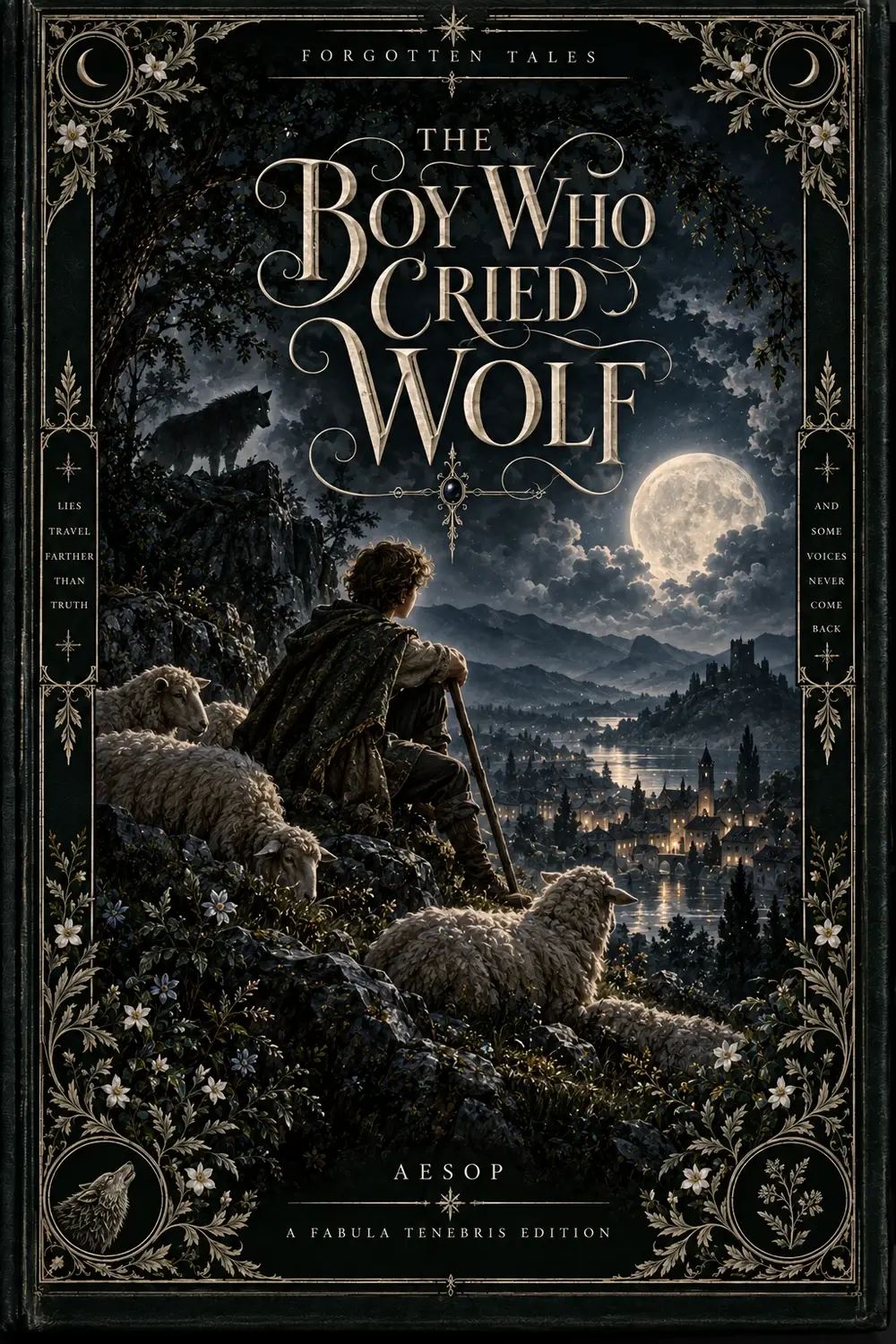
The Boy Who Cried Wolf
Ancient Greece · Perry Index 210
A Fabula Tenebris Edition
3 minute read
There was once a shepherd boy whose task was to watch the sheep of his village.
Every morning, he led the flock beyond the houses and up onto a green hillside.
There the sheep grazed.
And the boy watched them.
At first, he enjoyed the work.
He listened to the wind in the grass.
He watched clouds drift slowly across the sky.
He counted the sheep.
Then counted them again.
But after many days, the hillside began to feel very quiet.
Too quiet.
Nothing happened.
The sheep ate.
The birds sang.
The sun crossed the sky.
And the boy grew bored.
Far below him, he could see the villagers working in their fields and houses.
Then an idea came to him.
He climbed onto a rock.
He filled his lungs.
And shouted:
“Wolf! Wolf! A wolf is attacking the sheep!”
The villagers heard him.
Men dropped their tools.
Women came running from the houses.
Several people rushed up the hill carrying sticks, hoes, and anything else they could use to drive the animal away.
But when they reached the boy, there was no wolf.
Only sheep.
The boy laughed.
“You should have seen how quickly you ran!”
The villagers did not find it funny.
“You must never call for help when there is no danger,” one of them said.
The boy nodded.
But after they had gone back down the hill, he began laughing again.
A few days passed.
The hillside became quiet once more.
The sheep grazed.
The clouds passed.
The boy remembered how exciting it had been to see everyone running toward him.
So again he climbed onto the rock.
“Wolf!”
he shouted.
“Wolf! Help! The wolf is here!”
Once more the villagers came running.
Once more they found nothing.
And once more the boy laughed.
This time, no one laughed with him.
“You lied to us before,” said one villager.
“And now you have lied again.”
“What will happen when you truly need us?”
The boy shrugged.
There was no wolf.
So what did it matter?
The villagers returned home.
Then, one afternoon, the boy heard something moving near the edge of the woods.
He looked up.
A wolf stepped from between the trees.
The boy stopped breathing.
The wolf watched the sheep.
Then it moved closer.
This time there was no joke.
The boy climbed onto the rock.
“Wolf!”
he screamed.
“Wolf! Please! Help me!”
Far below, the villagers heard him.
One man looked toward the hill.
“He is doing it again.”
Another shook his head.
“Let him shout.”
The boy cried louder.
“Please! There really is a wolf!”
But no one came.
The wolf ran among the flock.
The sheep scattered across the hillside.
The boy shouted until his voice was hoarse.
Still no one came.
By the time the villagers finally looked toward the hill again, the wolf had already attacked the flock and driven many of the sheep away.
The boy sat alone in the grass.
He was no longer laughing.
That evening, the villagers helped gather what remained of the flock.
The boy walked home quietly beside them.
He had learned something that day that could not easily be repaired.
A lie does not disappear when the laughter ends.
It remains in the mind of the person who heard it.
And once trust has been broken often enough, even the truth may arrive too late.
The end.
About this edition
The Boy Who Cried Wolf is one of the fables traditionally attributed to Aesop, the semi-legendary Greek storyteller associated with a body of short moral tales transmitted and rewritten across many centuries. The fable is catalogued as Perry Index 210, traditionally known as The Shepherd Who Cried “Wolf!” in Jest or The Shepherd’s Boy and the Wolf. (ISFDB)
This Fabula Tenebris edition follows the familiar ancient fable tradition and was checked against public-domain English collections, including George Fyler Townsend’s Three Hundred Aesop’s Fables and V. S. Vernon Jones’s 1912 Aesop’s Fables. (Project Gutenberg)
Historical editions & further reading
These historical editions are offered for comparison and further reading. The supplied Fabula Tenebris edition above is not presented as a verbatim transcription of these sources.
Three Hundred Aesop’s Fables — Project Gutenberg — George Fyler Townsend’s English collection; a historical comparison source.