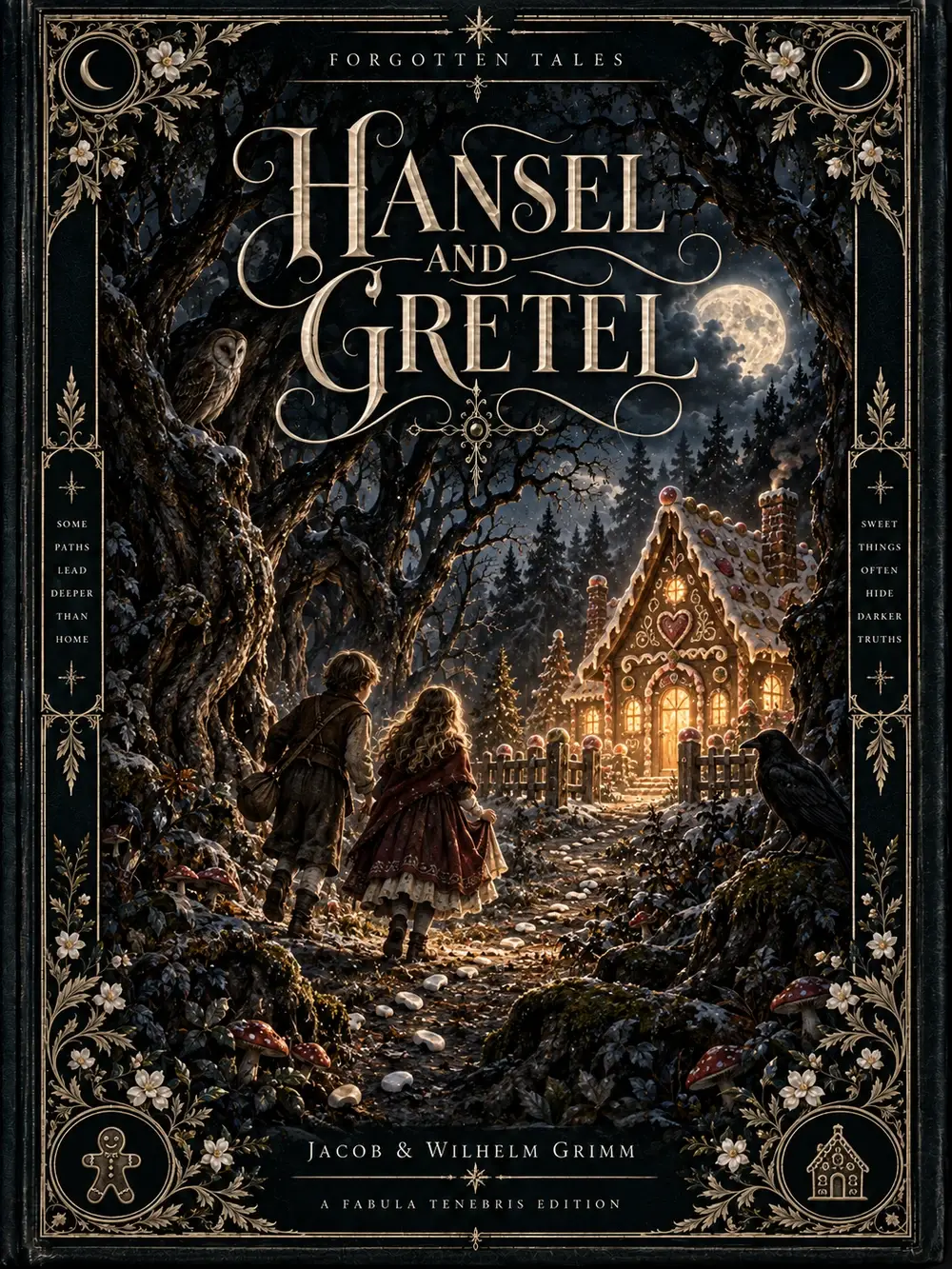
At the edge of a great forest lived a poor woodcutter with his wife and two children.
The boy was called Hansel.
The girl was called Gretel.
They had very little.
Even in good times, bread was scarce.
Then came a year when food became scarcer still.
The fields gave little.
Prices rose.
The cupboards emptied.
At night, the woodcutter lay awake listening to his children breathe.
One evening his wife whispered:
“We cannot feed them any longer.”
The man turned toward her.
“What are you saying?”
“Tomorrow, take them deep into the forest.”
His face changed.
“No.”
“Give them each a piece of bread. Light a fire for them. Then leave.”
“No.”
She spoke more sharply.
“If we keep them here, all four of us will starve.”
“They are my children.”
“And what good will that do them when there is nothing left to eat?”
The woodcutter covered his face.
He could not agree.
But his wife did not stop.
Again she spoke.
Again she argued.
Again she reminded him of the empty cupboard.
At last, exhausted and frightened, he gave in.
Hansel and Gretel were not asleep.
They had heard everything.
Gretel began to cry.
“We are going to die.”
Hansel took her hand.
“Do not be afraid.”
When the adults had fallen asleep, he climbed quietly from bed and slipped outside.
The moon shone brightly.
Small white stones glittered on the ground.
Hansel filled his pockets with as many as he could carry.
Then he returned to Gretel.
“Sleep now.”
“I know how we shall find our way home.”
At dawn, their mother woke them.
“Get up.”
“We are going into the forest.”
She gave each child a small piece of bread.
“Do not eat it before noon. You will get nothing else.”
Hansel hid his stones inside his coat.
Then they left.
As the family walked beneath the trees, Hansel kept stopping and looking back toward the house.
His father noticed.
“Why do you keep turning around?”
“I am looking at my white kitten.”
“It is sitting on the roof saying goodbye.”
His mother frowned.
“That is not your kitten.”
“That is the morning sun shining on the chimney.”
But Hansel was not looking at the house.
Each time he stopped, he dropped one of the white stones onto the path behind them.
They walked deeper into the forest.
And deeper still.
At last, the woodcutter stopped.
He gathered branches and built a fire.
“Sit here,” said the children's mother.
“Rest.”
“Your father and I will go farther into the forest to cut wood.”
“When we are finished, we will return for you.”
Hansel and Gretel sat beside the fire.
Far away they heard:
knock.
knock.
knock.
They thought it was their father striking a tree with his axe.
But he had tied a branch to a dead tree so that the wind would beat it against the trunk.
The sound continued.
knock.
knock.
knock.
Hours passed.
No one returned.
At last, the fire went out.
Night came.
Gretel began to cry.
Hansel waited.
“Not yet.”
The moon rose.
Its light entered the forest.
And one by one, the little white stones Hansel had dropped began to shine.
“There.”
He took Gretel's hand.
They followed the stones.
One after another.
Through the dark forest.
All night they walked.
And when morning came, they stood once more before their father's house.
They knocked.
Their mother opened the door.
“You wicked children!”
“Why did you stay so long in the forest?”
“We thought you were never coming home.”
But their father was overjoyed.
He had regretted abandoning them from the moment he left.
That evening, the children ate what little food remained.
And for a while, nothing more was said.
But the famine grew worse.
Soon the children once again heard their mother speaking in the night.
“There is nothing left.”
“If we do not get rid of them, we shall all die.”
The woodcutter protested.
She would not listen.
“This time we will take them farther.”
“So far into the forest that they will never find the road home.”
Gretel began trembling.
Hansel whispered:
“I will gather stones again.”
When the adults were asleep, he went to the door.
It would not open.
Their mother had locked it.
Hansel returned to bed.
“Do not be afraid.”
“I will think of something.”
The next morning, each child was given an even smaller piece of bread.
They walked once again into the forest.
Hansel kept turning around.
His father asked:
“What are you looking at this time?”
“My little white pigeon.”
“It is sitting on the roof.”
His mother looked back.
“That is not a pigeon.”
“That is the morning sun on the chimney.”
But Hansel had no stones.
So each time he turned, he broke off a small piece of bread and dropped it onto the path.
The family went much farther than before.
Deep into a part of the forest the children had never seen.
Again, the adults made a fire.
Again, they told the children to wait.
Again came the distant sound:
knock.
knock.
knock.
And again, no one returned.
When night came, Hansel waited for the moon.
Then he took Gretel's hand.
“Come.”
They searched for the bread crumbs.
But there were none.
Birds had eaten every piece.
Hansel looked one way.
Then another.
The forest was endless.
Still he told Gretel:
“We will find the way.”
They walked all night.
The next day too.
Nothing looked familiar.
By evening, their feet hurt.
Their stomachs ached.
They ate berries they found beside the path.
Then they slept beneath a tree.
The next morning, they continued.
They became weaker.
They no longer knew whether they were travelling toward home or farther away from it.
Then, on the third day, they heard a bird.
It was white.
Beautiful.
Its song was unlike anything they had heard before.
The children followed it.
The bird flew from branch to branch.
Never far enough to disappear.
Always just ahead.
At last, it landed on the roof of a little house.
Hansel and Gretel stopped.
The house was made of food.
Its walls were bread.
Its roof was cake.
Its windows glittered with clear sugar.
For a moment, neither child moved.
Then Hansel whispered:
“We shall eat.”
Hansel broke a piece from the roof.
Gretel pulled part of the window away.
They ate greedily.
Cake.
Bread.
Sugar.
Anything they could reach.
Then a voice came from inside.
“Nibble, nibble, little mouse.
Who is nibbling at my house?”
The children froze.
Hansel answered:
“The wind.
The wind.
The heavenly child.”
Then they continued eating.
The door opened.
An old woman stepped outside.
She leaned upon a stick.
Hansel and Gretel were frightened.
But the woman smiled.
“My dear children.”
“How did you come here?”
“Come inside.”
“No harm will come to you.”
She took them gently by the hands.
Inside was a table covered with food.
Milk.
Pancakes.
Sugar.
Apples.
Nuts.
The children ate until they could eat no more.
Then the old woman prepared two soft beds.
Hansel and Gretel climbed beneath the blankets.
For the first time in days, they were warm.
They believed they had been saved.
But the old woman was a witch.
And her house had not been built from sweets out of kindness.
She used it to lure children from the forest.
Whenever one came close enough,
she caught them.
Killed them.
Cooked them.
And ate them.
To her, a child was the finest feast in the world.
Before sunrise, the witch woke.
She looked at Hansel and Gretel sleeping.
“A fine meal,” she whispered.
She seized Hansel.
He woke screaming.
The witch carried him outside and locked him inside a small stable.
Then she returned for Gretel.
“Get up, lazy girl.”
“Bring water.”
“Cook something good for your brother.”
“We must fatten him.”
“And when he is fat enough, I will eat him.”
Gretel began to cry.
But there was nothing she could do.
Each day the witch prepared rich food for Hansel.
Gretel received almost nothing.
Each morning, the witch went to the stable.
“Hansel.”
“Put out your finger.”
“I want to see how fat you have become.”
The witch's eyes were weak.
She could barely see.
So Hansel did not offer his finger.
He found a small bone on the floor.
Whenever the witch reached through the bars, Hansel held out the bone instead.
She felt it.
“So thin!”
She became impatient.
Days passed.
Still the bone felt the same.
At last the witch shouted:
“Enough!”
“Fat or thin, I will eat him tomorrow.”
She called for Gretel.
“Bring water.”
“We will cook your brother.”
Gretel wept.
She looked toward the sky.
“If only the beasts of the forest had eaten us.”
“At least then we would have died together.”
“Stop crying,” said the witch.
“No one will help you.”
The next morning, the witch ordered Gretel to light the oven.
“We will bake first.”
“Then Hansel will go into the pot.”
Gretel gathered wood.
The fire grew.
The oven became hotter.
The witch leaned toward it.
“Crawl inside.”
“See whether it is hot enough.”
Gretel understood.
The witch intended to cook her too.
“I do not know how.”
The witch glared at her.
“You stupid girl.”
“The opening is large enough.”
“Look.”
She bent down.
“All you must do is crawl inside like this.”
Gretel moved behind her.
The witch leaned farther into the oven.
And Gretel pushed.
The old woman fell inside.
Gretel slammed the iron door.
The witch screamed.
She struck against the oven.
She cursed.
She begged.
Gretel did not open it.
The cries grew weaker.
Then stopped.
The witch burned to death inside her own oven.
Gretel ran to Hansel.
She unlocked the stable.
“Hansel!”
“The witch is dead!”
He threw his arms around her.
For a moment they could only laugh and cry.
Then they returned to the house.
Without the witch, it no longer seemed frightening.
They searched the rooms.
Inside chests and cupboards they found pearls.
Jewels.
Precious stones.
Gold.
Hansel filled his pockets.
Gretel filled her apron.
“These are better than stones,” Hansel said.
Then they left the house.
But they still did not know the way home.
They travelled for hours.
Eventually they reached a great stretch of water.
There was no bridge.
No boat.
Hansel looked across.
“We cannot cross.”
Then Gretel saw a white duck swimming nearby.
She called to it.
“Little duck, little duck,
Hansel and Gretel are waiting.
There is no bridge and no boat.
Please carry us across.”
The duck approached.
Hansel tried to climb onto its back with Gretel.
But Gretel stopped him.
“No.”
“That would be too heavy.”
“You go first.”
The duck carried Hansel across.
Then it returned for Gretel.
Together again, the children continued through the forest.
Slowly, the trees began to look familiar.
Hansel stopped.
“I know this place.”
They walked faster.
Soon they saw the roof of their house.
Then the chimney.
Then the door.
They ran.
Their father was inside.
When he saw them, he could hardly believe his eyes.
He ran toward them.
Hansel and Gretel threw themselves into his arms.
The woodcutter wept.
He had not known a peaceful moment since the day he abandoned them.
Their mother was dead.
The house was quiet.
Gretel opened her apron.
Pearls and jewels scattered across the floor.
Hansel emptied his pockets beside them.
The poor woodcutter stared.
There was enough wealth there to end their hunger forever.
The forest could no longer threaten them with starvation.
There would be bread.
There would be warmth.
There would be no reason to abandon anyone again.
Hansel looked at Gretel.
Gretel looked at Hansel.
They had entered the forest as children who could be discarded because there was not enough food.
They had crossed hunger.
Darkness.
A house built to devour them.
And an oven meant to become their grave.
But they had returned.
Together.
And from that day onward,
their hunger was at an end.
The end.
About this edition
Hansel and Gretel (Hänsel und Gretel) appears as KHM 15 in the Brothers Grimm's Kinder- und Hausmärchen and was present from the collection's first edition in 1812. The Grimms continued revising the story across later editions, with the seventh and final lifetime edition appearing in 1857. (Wikisource)
This Fabula Tenebris edition follows the mature Grimm narrative: the family's desperate hunger; the children's abandonment in the forest; Hansel's white stones and later bread crumbs; the edible house; the witch imprisoning and fattening Hansel; the bone he offers instead of his finger; Gretel pushing the witch into the oven; the treasure inside the house; and the children's eventual return home. The Grimms' own notes identify the tale as KHM 15 and describe its central traditional episodes, including abandonment, the trail home, the edible house, Hansel's deception of the witch, and her death in the oven. (Wikisource)
This edition was checked primarily against the Grimms' public-domain German texts preserved by Wikisource, including the 1812 first edition and the 1857 final lifetime edition. (Wikisource)
The historical tale & its ending
Is this the original Hansel and Gretel story?
It follows the mature Grimm narrative of Hänsel und Gretel, KHM 15. The tale appeared in the Grimms’ 1812 collection and was revised in later editions. Our English retelling is not the verbatim 1812 text; the edition notes explain its basis.
Why is the Grimm version of Hansel and Gretel dark?
Hunger leads to the children’s abandonment, and the witch’s house turns food into a trap. Hansel is imprisoned to be eaten, while Gretel must act to save them both. Their return home is hopeful, but the danger is not softened away.
Historical editions & further reading
These historical editions are offered for comparison and further reading. The supplied Fabula Tenebris edition above is not presented as a verbatim transcription of these sources.
Hänsel and Grethel — Grimm’s Household Tales, Volume 1 — Margaret Hunt’s historical English translation for comparison; not the wording of this retelling.