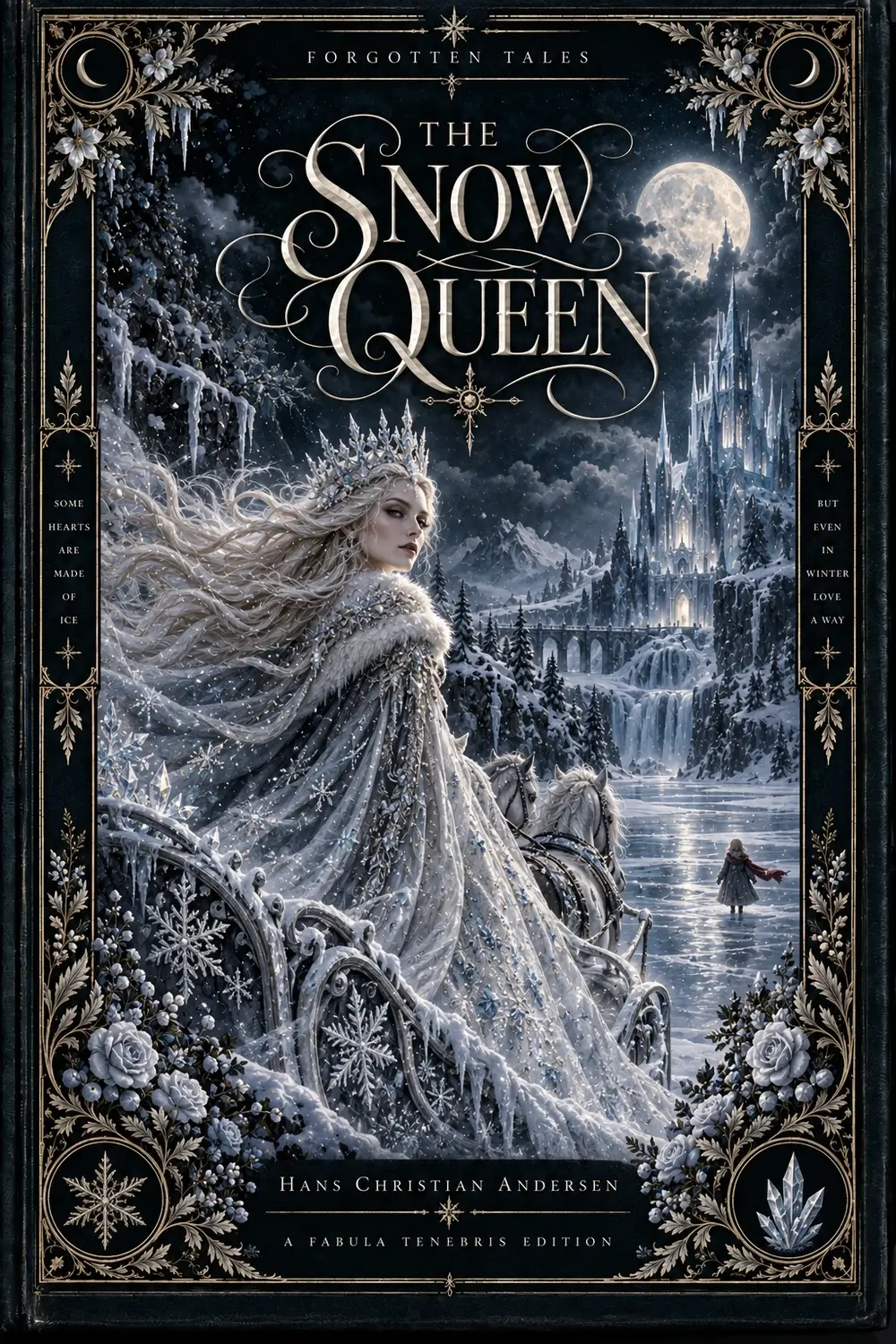
The Snow Queen
Denmark · 1844 · Literary Fairy Tale
A Fabula Tenebris Edition
15 minute read
Listen.
We are beginning a story.
And by the time we reach its end, perhaps we shall know more than we do now.
Long ago there lived a wicked magician.
Some said he was a troll.
Others said he was the Devil himself.
He delighted in making beautiful things ugly.
One day, he created a mirror unlike any other.
Anything good reflected in its surface became small and ridiculous.
Anything ugly became enormous.
A kind face looked foolish.
A beautiful landscape became twisted.
A gentle expression appeared weak.
The mirror did not merely show ugliness.
It taught anyone who looked through it to see ugliness everywhere.
The magician was delighted.
His students carried the mirror across the world.
They held it before people.
Before houses.
Before forests.
Before churches.
Before everything beautiful.
At last, they decided to carry it into heaven.
They wanted to laugh at the angels.
But as they climbed higher, the mirror began to tremble.
It slipped from their hands.
And fell.
The glass struck the earth.
It shattered into millions upon millions of pieces.
Some were large enough to become windows.
Others became spectacles.
But most were smaller than grains of sand.
They travelled upon the wind.
Some entered people's eyes.
And anyone who received such a fragment began to see the world as the mirror had seen it.
Everything beautiful became ridiculous.
Everything kind seemed foolish.
Everything imperfect became unbearable.
Worse still were the pieces that entered a person's heart.
There, the glass became cold.
And little by little, the heart around it turned to ice.
The mirror disappeared.
But its fragments remained.
And this story concerns two of them.
In a great city there lived two children.
Their families occupied rooms beneath neighbouring roofs.
The houses stood so close together that the children could visit one another simply by stepping across the narrow space between their windows.
Their names were Kay and Gerda.
They were not brother and sister.
But they loved one another almost as though they were.
Their homes were small.
There was no garden.
So their parents placed wooden boxes outside the windows and filled them with earth.
In each box grew vegetables.
And roses.
The roses climbed around the windows until, during summer, it almost seemed that Kay and Gerda lived inside a garden.
They sat together beneath them.
They looked through picture books.
Gerda taught Kay songs.
Kay showed Gerda things he had learned.
And an old grandmother told them stories.
One winter evening, while snow fell thickly beyond the glass, the grandmother spoke of the Snow Queen.
“Who is she?” asked Kay.
“The queen of the snowflakes.”
The grandmother pointed toward the window.
“Look closely.”
Snowflakes gathered against the pane.
“They are like little white bees.”
“Do they have a queen?” asked Gerda.
“Oh yes.”
The grandmother smiled.
“When the storm is strongest, she flies above them all.”
Kay looked toward the snow.
“What does she look like?”
“Beautiful.”
“Very beautiful.”
“But made entirely of ice.”
That night Kay stared through the window.
Snow continued falling.
Then one large snowflake settled upon the flower box.
It grew.
Larger.
Larger still.
Until it became the figure of a woman.
She was tall and pale.
Her dress seemed woven from snow.
Her eyes shone like cold stars.
She looked directly at Kay.
Then she smiled.
Kay became frightened.
He jumped away from the window.
And the Snow Queen vanished.
Spring came.
The roses opened.
Kay and Gerda sat together among them.
Then one afternoon Kay suddenly cried out.
“Something has struck my eye!”
Gerda leaned toward him.
“What?”
“My heart hurts too.”
He blinked.
The pain passed.
Neither child knew what had happened.
A tiny fragment of the enchanted mirror had entered Kay's eye.
Another had entered his heart.
Gerda brought him a rose.
Kay looked at it.
“What an ugly thing.”
Gerda laughed.
But Kay was serious.
“Look at those leaves.”
“They are crooked.”
“And that flower there has been eaten by a worm.”
He tore the roses from the box.
Gerda stared at him.
“Kay!”
He laughed.
“Why are you crying?”
“You look ridiculous.”
From that day, everything began to change.
Kay mocked the grandmother's stories.
He imitated neighbours.
He laughed at old people.
He ruined Gerda's games simply because he could.
Everything gentle seemed stupid to him.
Everything beautiful seemed flawed.
He became clever in ways that hurt.
When winter returned, Kay preferred playing with the older boys in the square.
They tied sledges to passing carts and let themselves be pulled through the snowy streets.
One day, a magnificent white sleigh entered the square.
Its driver wore a long white coat.
Kay fastened his little sledge behind it.
The sleigh moved.
At first, Kay laughed.
They travelled through one street.
Then another.
Then beyond the city gates.
Kay tried to release the rope.
It would not come free.
The snow became heavier.
The city disappeared.
At last the driver turned.
The white coat opened.
And beneath it sat the Snow Queen.
She was exactly as the grandmother had described.
Beautiful.
Pale.
Cold.
She lifted Kay into her sleigh.
He trembled.
“Are you cold?”
She kissed his forehead.
The kiss was colder than ice.
The cold travelled through him.
His heart seemed almost to stop.
But only for a moment.
Afterward, he no longer felt the weather.
She kissed him again.
And with that kiss, Kay forgot Gerda.
He forgot his grandmother.
He forgot his home.
The Snow Queen smiled.
“If I kissed you a third time,” she said, “you would die.”
Then the sleigh rose into the storm.
And together they disappeared into the snow.
When Kay did not come home, everyone searched for him.
No one found the little sledge.
No one had seen where he went.
People began to believe he had fallen into the river.
Winter passed.
Spring returned.
Gerda refused to believe that Kay was dead.
One morning, she put on her red shoes and went to the river.
“Did you take Kay?” she asked.
The water said nothing.
Gerda believed that perhaps she could give the river something in exchange for him.
She removed her beautiful red shoes.
Then she threw them into the water.
But the river pushed them back toward the bank.
Gerda climbed into a small boat.
She threw the shoes farther.
The boat slipped free from its rope.
At once, the current carried her away.
Gerda cried for help.
No one heard.
The river carried her beyond the city.
Past fields.
Past trees.
Farther and farther away.
At last the boat drifted toward a small house surrounded by a magnificent garden.
An old woman stood there.
She carried a crooked staff.
Her hat was painted with flowers.
The old woman pulled the boat toward shore.
“My poor little child.”
“How did you come here alone?”
Gerda told her about Kay.
The old woman listened.
She was not cruel.
But she was a witch.
And she liked Gerda very much.
So much that she wanted to keep her.
She combed Gerda's hair with a golden comb.
As she did, Gerda slowly forgot Kay.
The old woman had enchanted her.
Then she walked into the garden and touched every rose bush with her staff.
All the roses sank into the ground.
She knew that if Gerda saw them, they might remind her of home.
Gerda lived there happily.
For a time.
The garden was always warm.
Flowers bloomed in every direction.
There were no cold mornings.
No dead leaves.
No winter.
But something was missing.
One day, Gerda looked at the old woman's painted hat.
Among the flowers painted there was a rose.
Gerda stared at it.
“Roses.”
Something moved inside her memory.
She ran into the garden.
There were no roses anywhere.
She began to cry.
Her tears fell onto the earth.
Where they touched the ground, a rose bush rose from beneath the soil.
The flowers opened.
Gerda knelt beside them.
“Is Kay dead?”
The roses shook their heads.
“No.”
“We have been beneath the earth where the dead sleep.”
“Kay is not there.”
Gerda stood.
She remembered everything.
She ran from the garden.
The old woman's gate closed behind her.
Only then did Gerda realize how much time had passed.
Autumn had come.
Gerda walked until evening.
She met a crow.
The crow listened to her story.
“A boy named Kay?”
He tilted his head.
“I may know something.”
Gerda's heart leapt.
The crow told her that a princess in a nearby kingdom had recently decided to marry.
She wanted a husband who could speak intelligently.
Many young men had come to the palace.
One boy had arrived wearing poor clothes.
But he was clever.
He had not been afraid of the princess.
Perhaps, thought Gerda, this boy was Kay.
The crow helped her enter the palace secretly.
Gerda crept through dark halls.
At last she entered a bedchamber.
Two beds stood there.
One belonged to the princess.
In the other slept the young prince.
Gerda approached.
He turned in his sleep.
She saw his face.
It was not Kay.
Gerda began to cry.
The prince and princess woke.
When they heard her story, they were kind to her.
They gave her warm clothing.
Boots.
Food.
And a magnificent golden carriage.
Then Gerda continued north.
The golden carriage did not travel safely for long.
In a dark forest, robbers attacked it.
They killed the servants.
They took the horses.
They dragged Gerda from the carriage.
The robber chief's daughter looked at her.
She was wild.
Strong.
Her hair was black and tangled.
A knife hung from her belt.
“She is mine,” said the robber girl.
No one argued.
Gerda was taken into the robbers' home.
Animals were tied throughout the great hall.
Pigeons sat above them.
A reindeer was bound in one corner.
The robber girl made Gerda sleep beside her.
She kept a knife beneath her pillow.
“If you move while I am asleep,” she said, “I may stab you without waking.”
Gerda lay very still.
During the night, the pigeons began to speak.
“Coo. Coo.”
“We saw Kay.”
Gerda sat up.
“You saw him?”
“We saw a boy in the Snow Queen's sleigh.”
“She carried him north.”
“To Lapland.”
The reindeer lifted his head.
“Lapland?”
“I know Lapland.”
“I was born there.”
Gerda turned to the robber girl.
By morning, she had told her everything.
The robber girl stared at her for a long while.
Then she cut the reindeer's rope.
“You may go.”
She looked at the animal.
“Take the girl to the Snow Queen.”
The reindeer stamped his hooves.
The robber girl gave Gerda warm gloves and food.
Then she helped her climb onto his back.
“Do not fall off.”
Gerda hugged her.
The robber girl looked uncomfortable.
“Go.”
The reindeer ran.
They travelled north.
Farther than Gerda had ever imagined.
The forests changed.
The nights became longer.
The cold became sharper.
At last they reached a small hut.
Inside lived an old woman from Lapland.
There was scarcely room to stand.
The woman had no paper.
So she wrote a message upon a dried fish and sent Gerda onward to another woman in Finland.
The Finnish woman lived in a hot little room.
She read the message.
Then she read it again.
The reindeer told her Gerda's story.
“You must give her something,” he said.
“Some great power.”
“The strength of twelve men.”
The Finnish woman shook her head.
“Twelve men?”
“What use would that be?”
She pointed toward Gerda.
“Do you not see how powerful she already is?”
The reindeer stared.
“She has travelled farther than kings.”
“She has crossed rivers.”
“She has escaped enchantment.”
“She has entered palaces.”
“She has survived robbers.”
“She has come all this way with nothing but love for one boy.”
The woman looked at Gerda.
“There is no greater power I can give her.”
She told them that Kay was indeed with the Snow Queen.
A fragment of enchanted glass remained in his eye.
Another remained in his heart.
“That is why he sees ugliness where there is beauty.”
“And why his heart is cold.”
The reindeer lowered his head.
“Can you remove them?”
“No.”
“Only Gerda can do that.”
The Finnish woman wrapped Gerda warmly.
Then she whispered directions.
The reindeer carried her farther north.
At last they reached the Snow Queen's land.
There the wind itself seemed alive.
Snowflakes gathered around them.
They became enormous white creatures.
Some resembled snakes.
Some bears.
Some wolves.
Gerda tried to walk.
The creatures surrounded her.
She began to pray.
As she prayed, her breath became visible.
It rose into the air.
And from it appeared shining angels.
They carried helmets.
Spears.
Shields.
The angels struck the snow creatures.
The shapes shattered into harmless flakes.
Gerda continued onward.
Alone.
The Snow Queen's palace was enormous.
Its walls were formed from drifting snow.
Its windows were cut from freezing wind.
There were no doors.
No fires.
No warmth.
The Northern Lights burned above its roof.
Inside, halls stretched farther than Gerda could see.
Empty.
Perfect.
Cold.
At the center lay a frozen lake.
Its surface had cracked into thousands of pieces.
Every piece seemed shaped with perfect precision.
The Snow Queen called it the Mirror of Reason.
Kay sat beside it.
He was almost blue with cold.
But he did not feel it.
The Snow Queen had kissed the memory of cold from him.
Before him lay pieces of ice.
He moved them endlessly.
He arranged them into shapes.
Triangles.
Squares.
Words.
The Snow Queen had given him a task.
“If you can arrange the pieces to form the word ETERNITY,” she had told him, “you shall be your own master.”
“And I will give you the whole world.”
“And a new pair of skates.”
But Kay could never make the word.
The fragment in his eye made the ice shapes seem more important than anything else in existence.
The fragment in his heart kept him from caring.
The Snow Queen was not there.
She had travelled south.
She intended to cover volcanoes with snow.
So Kay sat alone.
Moving pieces of ice.
Again.
And again.
Then Gerda entered the hall.
She saw him.
“Kay!”
He did not move.
She ran toward him.
She threw her arms around his neck.
He remained stiff.
Cold.
Silent.
Gerda began to cry.
Her tears fell onto his chest.
They reached his heart.
The warmth travelled inward.
The ice began to melt.
The fragment of mirror loosened.
Kay looked at her.
Gerda sang the little song they had sung together beneath the roses at home.
Kay blinked.
His eyes filled with tears.
And with those tears, the fragment of mirror washed out.
He looked at Gerda properly.
For the first time in years.
“Gerda?”
She laughed through her tears.
Kay began to cry too.
He cried until all the coldness inside him seemed to disappear.
He held her.
“Gerda.”
“Where have you been?”
Gerda laughed again.
“Where have I been?”
She looked around the endless frozen palace.
“Where have you been?”
They clung to each other.
Around them, the pieces of ice began to move.
They danced across the frozen lake.
Turning.
Sliding.
Rearranging themselves.
At last they became letters.
One word.
ETERNITY.
The task was complete.
Kay was free.
But neither child cared about the Snow Queen's promised world.
Or the new skates.
They wanted only to go home.
Gerda and Kay left the frozen palace.
The reindeer was waiting.
He carried them south.
They returned to the Finnish woman.
Then the woman in Lapland.
Farther south, they met the robber girl again.
She was older now.
Her hair was still wild.
Her knife still hung at her side.
She laughed when she saw Kay.
“So this is the boy?”
Gerda smiled.
“Yes.”
The robber girl looked at him.
“You caused a great deal of trouble.”
Kay did not know what to say.
The robber girl gave Gerda a horse.
Then she rode away into the forest.
The children continued.
They passed through countries Gerda had crossed alone.
Spring returned.
Then summer.
At last, they saw the city.
The familiar roofs.
The windows.
The little wooden boxes.
The roses.
Gerda and Kay climbed the stairs.
They entered the old rooms.
Everything seemed smaller.
Then they understood.
They were no longer children.
They had grown.
The grandmother sat in her chair reading.
The roses bloomed around the windows.
Kay and Gerda sat beneath them again.
For a moment, it seemed that no time had passed.
Then they looked at one another.
They remembered everything.
The mirror.
The river.
The witch's garden.
The palace.
The robber girl.
The reindeer.
The endless snow.
The Snow Queen.
And the frozen word:
ETERNITY.
Outside, summer sunlight warmed the roses.
And although they had returned home as adults, somewhere within them remained the two children who had once sat beneath those same flowers,
holding hands,
while snow fell beyond the glass.
The end.
About this edition
The Snow Queen (Snedronningen) is a literary fairy tale written by Hans Christian Andersen. It was first published in Denmark in 1844 and is structured as seven connected stories, beginning with the demonic mirror and following Gerda's long journey to recover Kay from the Snow Queen. Historical English translations preserve that same seven-part structure and the major episodes of Andersen's original narrative. (Project Gutenberg)
This Fabula Tenebris edition follows Andersen's original story closely: the mirror that distorts everything good and beautiful; its fragments entering Kay's eye and heart; the Snow Queen taking him north; Gerda's enchantment in the old woman's garden; the crow and royal couple; the robber girl and reindeer; the women of Lapland and Finland; Gerda reaching the Snow Queen's palace; her tears melting the ice around Kay's heart; and the pieces of ice finally forming the word “Eternity.” It was checked against multiple public-domain English translations preserved by Wikisource and Project Gutenberg. (Wikisource)
The historical tale & its ending
What is the original Snow Queen story about?
Andersen’s 1844 tale follows Gerda as she searches for Kay after he is taken by the Snow Queen. Shards of a magical mirror have altered his sight and frozen his heart. The seven connected stories explore friendship, enchantment and Gerda’s determination to bring him home.
Does The Snow Queen have a dark or a happy ending?
The journey contains frightening encounters and the icy loss of affection, but the ending is restorative. Gerda reaches Kay, her tears melt the ice in his heart, and they return home. Calling every historical fairy tale tragic would miss what makes this one distinctive.
Historical editions & further reading
These historical editions are offered for comparison and further reading. The supplied Fabula Tenebris edition above is not presented as a verbatim transcription of these sources.
The Snow Queen — Andersen’s Fairy Tales — Historical English text for comparison; not the wording of this retelling.
The Snow Queen — Hans Christian Andersen Centre — University of Southern Denmark publication record: 21 December 1844.