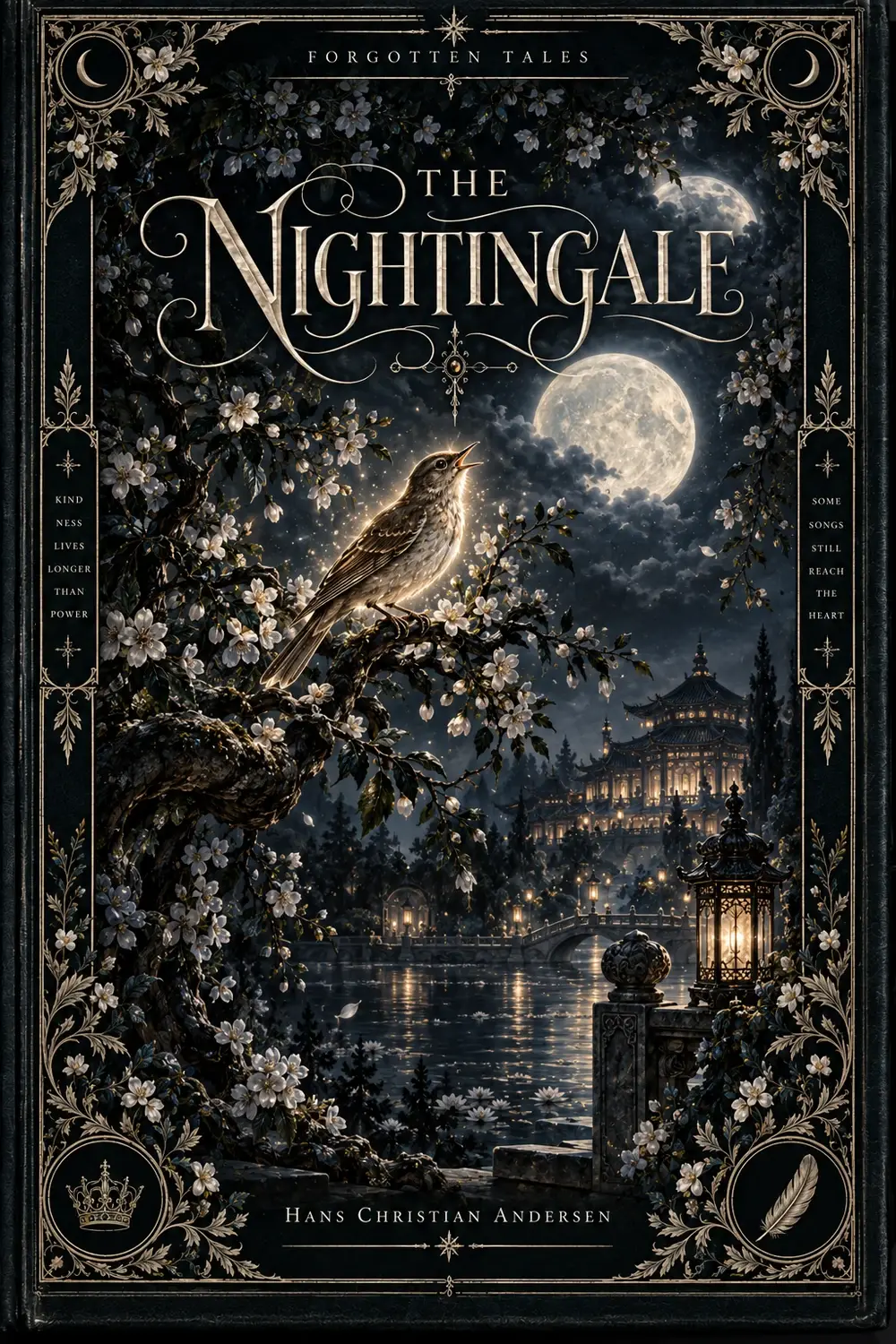
The Nightingale
Denmark · 1843 · Literary Fairy Tale
A Fabula Tenebris Edition
11 minute read
In China, long ago, there lived an Emperor whose palace was said to be the most magnificent in the world.
It was made almost entirely of porcelain.
The walls shone.
The floors gleamed.
The smallest ornament was delicate enough that a careless hand might break it.
Around the palace stretched an enormous garden filled with extraordinary flowers. Silver bells had been tied to the most beautiful blossoms so that anyone passing nearby would hear their delicate ringing and remember to look at them.
The garden continued farther than even the royal gardener could describe.
Beyond its ordered paths and carefully tended flowers, it became a forest.
And beyond the forest lay the deep blue sea.
Great ships passed beneath the branches of enormous trees.
There, among those trees, lived a small gray bird.
A Nightingale.
Its feathers were plain.
Its body was small.
Nothing about it seemed remarkable until it opened its beak and sang.
Then sailors on the sea would stop to listen.
Travellers resting beneath the trees forgot how tired they were.
Even poor fishermen, busy with their nets, sometimes paused when the song drifted across the water.
“That is beautiful,” they would say.
Then they would return to their work.
People came from distant countries to see the Emperor's palace.
They admired the porcelain halls.
They admired the flowers.
They admired the garden.
But when visitors travelled far enough into the forest and heard the Nightingale, they would say:
“This is the most beautiful thing of all.”
Poets wrote about it.
Travellers described it in books.
One day, a great book reached the Emperor.
It had been written by someone who had travelled through his entire realm.
The Emperor opened it proudly.
There were pages praising his palace.
Pages praising his gardens.
Pages praising the city.
But at the end, he found these words:
The most beautiful thing in the Emperor's kingdom is the song of the Nightingale.
The Emperor stared at the page.
“The Nightingale?”
He had never heard of it.
He rang for his chief courtier.
“There is apparently a remarkable bird living somewhere in my gardens.”
The courtier bowed.
“I have never heard of it, Your Majesty.”
“Then why has it been written about in books?”
The courtier did not know.
“I want to hear this bird tonight,” said the Emperor. “Find it.”
The courtier hurried away.
He questioned ministers.
They questioned officials.
The officials questioned servants.
No one knew anything about a Nightingale.
At last, someone remembered a young kitchen maid.
She had heard the bird.
Every evening, after finishing her work, the girl carried scraps of food to her sick mother, who lived near the shore.
On the walk home, she often rested beneath the trees.
“There is a little bird there,” she said. “It sings more beautifully than anything I know. Sometimes when I hear it, I think my mother is kissing me.”
The chief courtier looked relieved.
“You will take us to it.”
That evening, half the court marched into the garden.
They wore silk.
They wore jewels.
They wore embroidered shoes completely unsuitable for walking through a forest.
The kitchen maid led them onward.
Suddenly they heard a cow lowing in the distance.
One of the courtiers stopped.
“There it is!”
“What extraordinary power!”
The kitchen maid laughed.
“That is a cow.”
They continued.
Then frogs began croaking in a pond.
Another courtier raised his hands.
“Magnificent! It sounds like little church bells.”
“No,” said the girl. “Those are frogs.”
They walked deeper into the forest.
At last, the Nightingale began to sing.
The kitchen maid pointed toward a branch.
“There.”
The courtiers stared.
The little bird was gray.
That was all.
“Surely not,” whispered one.
“It looks very ordinary.”
“Perhaps its color has faded from seeing so many distinguished people.”
The chief courtier stepped forward.
“Little Nightingale,” he said, “His Imperial Majesty wishes you to sing before him tonight.”
The bird tilted its head.
“My song sounds best among the trees.”
“But the Emperor commands it.”
The Nightingale thought for a moment.
Then it agreed.
“I will come.”
That evening, the palace had been prepared as though for a great celebration.
Thousands of lamps illuminated the porcelain halls.
Flowers covered the corridors.
The little silver bells on them rang whenever someone passed.
At the center of the great hall sat the Emperor upon his golden throne.
Beside him had been placed a small golden perch for the Nightingale.
The court assembled.
The kitchen maid had been allowed to stand behind the door.
The Nightingale landed upon the golden perch.
Then it sang.
The hall became completely still.
The Emperor listened.
The little gray bird's song filled the room with something no goldsmith could make and no minister could explain.
It was joyful.
Then sorrowful.
Then gentle enough to make the vast palace seem suddenly small and quiet.
A tear formed in the Emperor's eye.
It rolled slowly down his cheek.
The Nightingale saw it.
And it sang more beautifully still.
When the song ended, the Emperor stood.
He was deeply moved.
He offered the Nightingale his golden slipper to wear around its neck.
But the bird declined.
“I have already received my reward.”
“What reward?”
“I saw tears in the Emperor's eyes.”
The Nightingale bowed.
“That is treasure enough for a singer.”
The Emperor was delighted.
The court applauded.
And from that night forward, the Nightingale became the most celebrated creature in the empire.
It was given a place at court.
A cage was prepared.
Twelve servants were assigned to it.
Twice each day and once each night, the Nightingale was permitted to go outside.
But twelve silk ribbons were tied to its legs, and twelve servants held them.
The court considered this a great honor.
The Nightingale did not.
Still, it sang.
Everyone wanted to imitate it.
Ladies filled their mouths with water and tried to produce little trills.
Officials made strange noises during banquets.
People greeted one another by saying:
“Nightingale!”
And the other would answer:
“Gale!”
The court declared itself very musical.
Then one day, a great package arrived.
Upon it were written the words:
FOR THE EMPEROR.
Inside was a magnificent artificial bird.
It had been made to resemble a Nightingale, but its body glittered with diamonds, rubies, and sapphires.
A golden key projected from its side.
When the key was wound, the mechanical bird began to sing.
Its tail moved up and down.
Jewels flashed in the light.
The court was amazed.
“What craftsmanship!”
“What precision!”
“What beauty!”
The artificial bird sang one melody.
It sang it perfectly.
Again.
And again.
And again.
The real Nightingale stood nearby.
“Let them sing together!” someone cried.
So they tried.
But it did not work.
The mechanical bird followed its fixed melody.
The living Nightingale sang freely, changing its rhythm and song as it wished.
They could not remain together.
The court musician shook his head.
“The artificial bird is superior.”
Everyone turned to him.
“You see,” he explained, “with the real Nightingale, one never knows what will come next.”
He pointed proudly toward the jeweled machine.
“But with this bird, everything can be explained.”
That sounded very impressive.
So the artificial bird sang thirty-three times.
It never became tired.
The court might have listened thirty-four times, but the Emperor suddenly remembered the real Nightingale.
“Now let us hear the living bird.”
But the window was open.
The Nightingale was gone.
It had flown back to the forest.
“What ingratitude!” cried the courtiers.
The Emperor was offended.
He banished the real Nightingale from the kingdom.
The artificial bird was given the title:
Chief Imperial Singer of the Bedside Table.
It was placed beside the Emperor's bed.
Everywhere around it were gifts of gold and jewels.
The court musician wrote twenty-five enormous volumes explaining its music.
The books were very learned.
They contained many difficult words.
Everyone said they had read them.
Very few had.
For a year, everything went perfectly.
The Emperor listened to the same melody.
The court listened to the same melody.
Soon everyone could hum every note.
“That is the advantage,” said the court musician. “The people understand it completely.”
Then one night, while the artificial bird was singing—
crack.
Something broke inside it.
The gears spun.
The music stopped.
The Emperor called for the royal physician.
The physician could do nothing.
So they called a watchmaker.
He opened the bird and inspected its tiny machinery.
After many hours, he managed to repair it.
But he warned them:
“The mechanism is badly worn.”
The mechanical bird could no longer sing often.
From then on, it was allowed to perform only once each year.
The court musician gave a speech explaining that it sounded just as beautiful as ever.
Everyone agreed.
Because he was the court musician.
Five years passed.
Then the Emperor became very ill.
The entire country heard that he might die.
A new Emperor was already being discussed.
Servants moved quietly through the palace.
Courtiers gathered in corridors and whispered.
The old Emperor lay in his enormous bed.
His face was pale.
His hands were cold.
The room was silent.
The artificial Nightingale rested upon a cushion beside him.
“Music,” whispered the Emperor.
No one answered.
“Music.”
He wanted the little jeweled bird to sing.
Something.
Anything.
But there was no one there to wind it.
The Emperor could barely breathe.
Then he felt something heavy upon his chest.
He opened his eyes.
Death was sitting there.
Death wore the Emperor's crown.
Death held the Emperor's golden sword.
Around the bed appeared strange faces.
Some were beautiful.
Some were terrible.
They were the Emperor's deeds.
The good things he had done.
And the cruel things.
They leaned close to him.
“Do you remember?”
they whispered.
“Do you remember this?”
“And this?”
The Emperor turned his head.
“No.”
“Do you remember?”
Their voices multiplied.
The room seemed full of them.
“Music!” cried the Emperor weakly.
“Music! Beat the great Chinese drums! Drown out their voices!”
Nothing happened.
The jeweled bird remained silent.
Death watched him.
Then, beyond the window, a song began.
The real Nightingale had returned.
It had heard that the Emperor was dying.
It sat outside upon a branch.
And it sang.
It sang of spring.
It sang of flowers opening in the forest.
It sang of sunlight on leaves.
It sang of the sea.
The terrible faces around the bed grew quieter.
The Emperor's breathing became easier.
Death listened.
“Beautiful,” Death whispered.
“Continue.”
The Nightingale sang of a peaceful churchyard beneath white roses.
Of grass wet with tears.
Of trees bending over quiet graves.
Death became homesick for his own garden.
“Continue,” he said.
The Nightingale stopped.
“What will you give me?”
Death looked toward the Emperor.
“For one song, give me his golden sword.”
Death surrendered the sword.
The Nightingale sang again.
“For another, give me his banner.”
Death surrendered the banner.
The Nightingale sang once more.
The song became so beautiful that Death rose from the Emperor's chest.
The room grew lighter.
The terrible faces disappeared.
Death drifted toward the open window like cold white mist.
And then he was gone.
The Nightingale continued singing.
Color returned slowly to the Emperor's face.
Warmth returned to his hands.
At last, he opened his eyes fully.
“Thank you,” he whispered.
The Nightingale looked at him.
“I remember you.”
The Emperor began to cry.
“You saved my life.”
“I saw tears in your eyes once before,” said the Nightingale. “A singer does not forget such things.”
The Emperor looked toward the jeweled mechanical bird.
“Stay with me.”
He promised to destroy the artificial Nightingale.
But the living bird stopped him.
“Do not destroy it.”
“It did what it could.”
The Emperor nodded.
“Then you shall remain here instead. You may sing whenever you wish.”
The Nightingale shook its head.
“I cannot live in the palace.”
The Emperor's face fell.
“But I will come.”
The Nightingale hopped closer to the window.
“I will sit upon the branch outside.”
“I will sing to you.”
“And I will tell you what happens beyond these walls.”
The Emperor listened.
“I will sing of the happy.”
“And of those who suffer.”
“Of good things hidden from you.”
“And evil things hidden from you.”
The Emperor lowered his head.
“My little singing bird will know more about my kingdom than I do.”
The Nightingale continued:
“But you must promise me something.”
“Anything.”
“Do not tell anyone that you have a little bird who tells you everything.”
The Emperor smiled.
“I promise.”
The Nightingale flew away.
The following morning, the servants entered the Emperor's chamber.
They expected to find him dead.
Instead, he was sitting upright in his bed.
He looked at them.
And said:
“Good morning.”
Far beyond the palace windows, somewhere among the trees, a little gray bird began to sing.
The end.
About this edition
The Nightingale (Nattergalen) is a literary fairy tale written by Hans Christian Andersen. It was first published in Copenhagen in 1843 as part of Nye Eventyr. Første Bind. Første Samling (New Fairy Tales. First Volume. First Collection), alongside works including The Ugly Duckling. Unlike many works in The Forgotten Library, this is not an anonymously transmitted folktale later collected by Andersen; it is an authored nineteenth-century fairy tale. (Wikipedia)
This Fabula Tenebris edition follows Andersen's original narrative closely and was checked against older public-domain English translations, particularly H. W. Dulcken's nineteenth-century translation, preserved in an 1898 edition by Project Gutenberg, as well as other historical English editions collected on Wikisource. (Project Gutenberg)
Historical editions & further reading
These historical editions are offered for comparison and further reading. The supplied Fabula Tenebris edition above is not presented as a verbatim transcription of these sources.
Andersen’s Fairy Tales — Project Gutenberg — Historical collection including The Nightingale; for further reading and comparison.