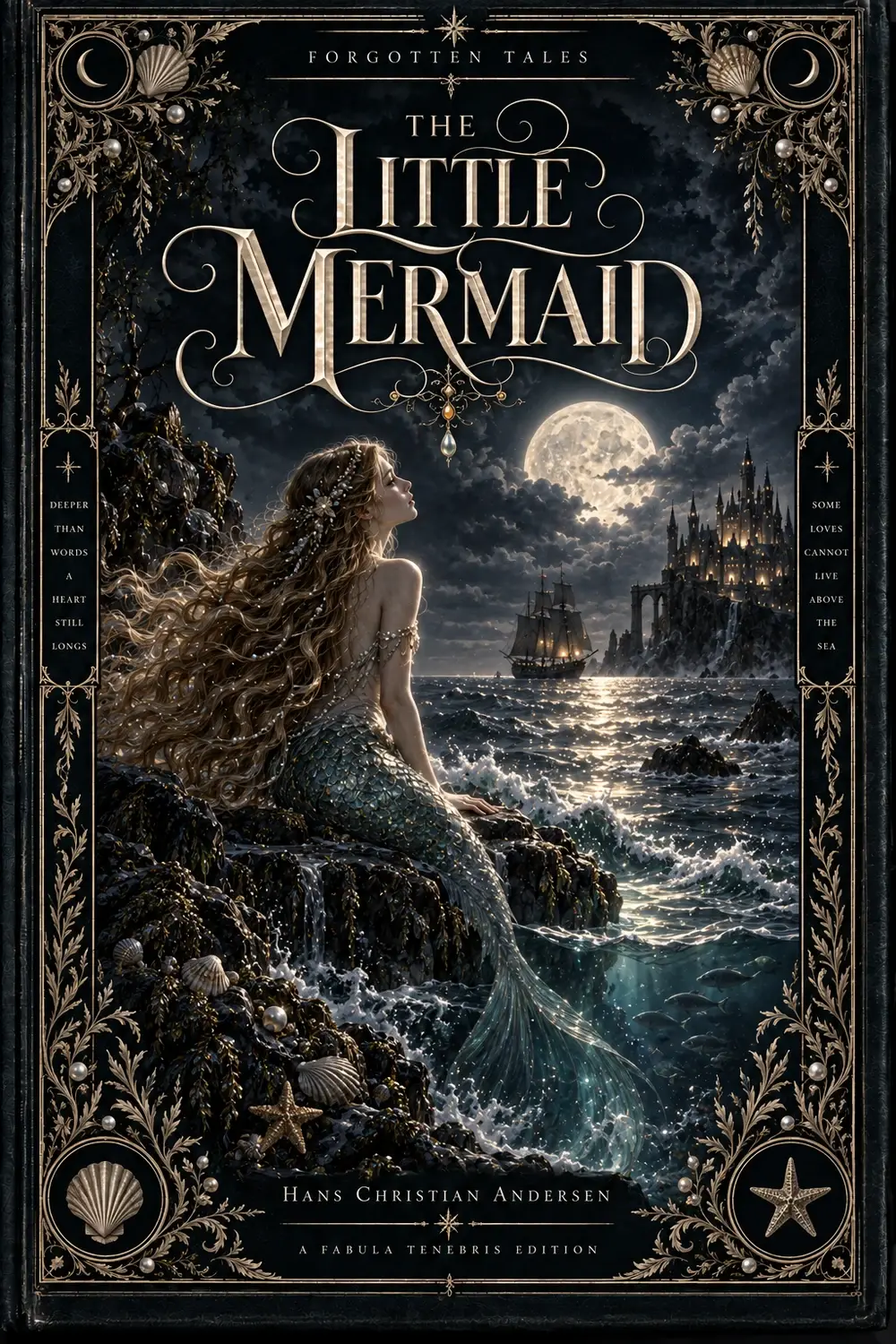
The Little Mermaid
Denmark · 1837 · Literary Fairy Tale
A Fabula Tenebris Edition
16 minute read
Far out beneath the sea, the water was blue as the petals of a cornflower and clear as the finest glass.
But it was very deep.
So deep that no anchor rope could reach the bottom.
So deep that if church towers were piled one upon another, they would still struggle to rise from the seabed into the air.
Down there lived the people of the sea.
The bottom was not empty.
Strange trees grew from the pale sand.
Their branches and leaves were so soft that they moved with the smallest current as though they were alive.
Fish slipped between them like birds through a forest.
And in the deepest part of all stood the palace of the Sea King.
Its walls were made of coral.
Its tall windows were amber.
The roof was formed from enormous shells that opened and closed with the movement of the water.
Inside each shell rested a pearl.
Even one would have been precious enough for a queen's crown.
The Sea King had been a widower for many years.
His old mother kept his household for him.
She was proud of her noble birth and wore twelve oysters upon her tail, while other great ladies of the sea were permitted only six.
But she was wise.
And she loved her six granddaughters dearly.
The six mermaid princesses were beautiful.
The youngest was the loveliest of them all.
Her skin was delicate and clear.
Her eyes were blue and deep.
Like all mermaids, she had no legs.
Below her waist was the long silver-green tail of a fish.
The sisters played in the great halls of the palace and among the gardens outside.
Each princess had a small garden of her own.
Five decorated theirs with treasures from sunken ships.
Bright shells.
Pearls.
Strange objects dropped from the world above.
But the youngest made her garden round like the sun.
She planted only flowers as red as sunset.
At its center she placed a white marble statue of a beautiful boy.
The statue had fallen from a ship and come to rest upon the seabed.
The little mermaid often sat beside it.
More than anything, she loved hearing stories about the world above the water.
Her grandmother told her about cities.
About forests.
About birds.
About flowers with scents carried through the air.
About bells ringing from church towers.
About human beings.
“When may I rise to the surface?” the youngest asked.
“When you are fifteen,” said her grandmother.
“Then you may sit upon the rocks beneath the moonlight and see the ships and cities for yourself.”
Fifteen years seemed impossibly far away.
One by one, the older sisters reached their fifteenth birthdays.
One by one, they rose to the surface.
And one by one, they returned with stories.
The eldest had seen a city at sunset.
Hundreds of lights appeared in the windows as the sky grew dark.
Music drifted from streets she could not see.
Church bells rang above the rooftops.
The second sister rose while the sun was setting over the sea.
She watched the clouds turn gold, crimson, and violet.
The third swam into a river.
She saw green hills.
Vineyards.
Children playing in the water.
The fourth remained far from land and discovered that the open sea itself could be beautiful beneath the night sky.
The fifth reached the surface during winter.
She saw icebergs floating like enormous diamonds.
Each sister returned full of wonder.
But after they had visited the surface many times, they began to think of it as ordinary.
The youngest never did.
She listened to every story.
She stood beneath the dark water and looked upward.
Sometimes she could see the moon shining above her like a pale coin.
Sometimes the shadow of a ship passed across the surface.
And she waited.
At last, she turned fifteen.
Her grandmother decorated her carefully.
Eight large oysters were fastened to her tail to show her rank.
The little mermaid winced.
“Beauty has its price,” said her grandmother.
Then the youngest princess rose toward the surface.
The sun had already begun to disappear when her head emerged from the sea.
Far away, clouds glowed with the last light of evening.
Closer to her floated a great ship.
Hundreds of lamps had been lit along its decks.
Music carried across the water.
The little mermaid swam nearer.
Flags moved above the masts.
People in beautiful clothing crowded the deck.
And among them she saw a young prince.
He could not have been more than sixteen.
Dark eyes.
Fine features.
Black hair beneath a small cap.
He looked so much like the marble statue in her garden that for a moment she could only stare.
The celebration was for him.
It was his birthday.
Sailors danced.
Musicians played.
Then fireworks burst above the ship.
The little mermaid cried out and disappeared beneath the water.
She had never seen fire in the sky.
When she rose again, golden stars were falling toward the sea.
The prince laughed beneath them.
She watched him long after the fireworks ended.
Then the wind changed.
Clouds gathered.
The waves grew larger.
The sailors began pulling down the sails.
The little mermaid knew what was coming.
A storm.
The ship rose and fell beneath enormous waves.
The masts bent.
Lightning crossed the sky.
The vessel cracked.
People screamed.
Then the ship broke apart.
The prince fell into the sea.
At first the little mermaid was delighted.
Now he would come down to her world.
Then she remembered.
Humans could not breathe beneath the water.
She found him among the wreckage.
His eyes were closed.
His body sank.
The little mermaid caught him.
She lifted his head above the waves.
All night she held him there.
The storm slowly weakened.
By morning, the sea had become calm.
The sun rose.
The prince did not wake.
The little mermaid carried him toward land.
At last she reached a place where a great white building stood beyond the shore.
Young girls moved through its gardens.
She laid the prince upon the sand where the sun could warm him.
Then she hid behind rocks farther out in the water.
Soon a girl came walking along the shore.
She saw the prince.
She called for others.
People gathered around him.
At last, he opened his eyes.
The little mermaid smiled.
He was alive.
But he never saw her.
He smiled instead at the girl standing above him.
The little mermaid slipped quietly beneath the sea.
She returned to the palace changed.
For days she told no one what had happened.
She became quieter.
She spent long hours sitting in her garden with her arms around the marble statue.
At last one of her sisters discovered her secret.
Soon all six knew.
One of them knew where the prince lived.
Together they swam toward his kingdom.
There, beside the sea, stood a magnificent palace.
The little mermaid began visiting it.
At night she watched the prince from the water.
Sometimes she swam closer than she should have.
She saw fishermen working beside their boats.
She heard people speak kindly of the prince.
And the more she learned about humans, the more she wanted to understand them.
One evening she asked her grandmother:
“Do human beings die as we do?”
“Of course,” said the old woman.
“Their lives are shorter than ours.”
“How long do we live?”
“Three hundred years.”
The little mermaid was astonished.
“And then?”
“Then we become foam upon the sea.”
The girl looked at her.
“Nothing remains?”
“No.”
The grandmother explained that mermaids possessed no immortal soul.
Human lives were brief.
But something within them continued after death.
It rose beyond the stars.
The little mermaid looked upward.
She had always wanted the human world.
Now she wanted something greater.
“Can a mermaid ever gain an immortal soul?”
“Only if a human being loved you more than father and mother.”
Her grandmother smiled sadly.
“If all his thoughts and all his love belonged to you, and if he joined his life to yours before heaven, then something of his soul would pass into you.”
The old woman touched her tail.
“But that will never happen.”
“To humans, this beautiful tail of ours is ugly.”
“They believe one must have two awkward things called legs to be beautiful.”
That night the little mermaid rose toward the prince's palace.
Music drifted across the water.
She watched people dancing inside.
She looked down at her tail.
Then toward the distant place where an old sea witch lived.
The road to the witch's home passed through terrible places.
The water became dark.
No flowers grew there.
Only grey sand and boiling mud.
Then came a forest of strange creatures that were half plant and half animal.
Their branches were long arms.
Anything they caught was held forever.
The little mermaid tied her hair tightly around her head and swam between them.
Skeletons hung in their grasp.
Bones from drowned sailors.
The remains of animals.
Even the skeleton of another mermaid.
Still she continued.
At last she reached the witch's house.
The sea witch was waiting.
“I know what you want,” she said.
“You want to be rid of your tail.”
“You want two human legs.”
“You want the prince to love you.”
The little mermaid said nothing.
The witch laughed.
“It is foolish.”
“But you have come at the right time.”
She placed a great pot over the fire.
“I can make you a drink.”
“When you reach the shore, you will swallow it.”
“Your tail will divide.”
“You will have the most beautiful human legs anyone has ever seen.”
The little mermaid's eyes brightened.
“But it will hurt.”
The witch leaned closer.
“It will feel as though a sword has passed through your body.”
“And every step you take afterward will feel as though you are walking upon sharp knives.”
The little mermaid became pale.
“Still, you will walk more gracefully than any human woman.”
“I accept.”
“There is more.”
The witch smiled.
“Once you become human, you can never become a mermaid again.”
“You will never return to your father's palace.”
“And if the prince marries another woman, your heart will break on the morning after their wedding.”
“You will become foam upon the sea.”
The little mermaid thought of the prince.
Then of the immortal soul.
“I accept.”
“Then you must pay me.”
“I have no gold.”
“I do not want gold.”
The witch looked at her mouth.
“You possess the loveliest voice beneath the sea.”
“That is my price.”
The little mermaid touched her throat.
“If you take my voice, what will remain to make him love me?”
“Your beautiful face.”
“Your graceful body.”
“And those expressive eyes.”
The little mermaid hesitated.
Then she nodded.
The sea witch took out a knife.
“Open your mouth.”
The little mermaid did.
And the witch cut out her tongue.
The potion was ready.
The little mermaid took it and fled.
She passed once more through the grasping forest.
She returned to her father's palace.
Everyone inside was sleeping.
She did not enter.
She looked through the windows.
At her father.
At her grandmother.
At her sisters.
Then she kissed her hand and pressed it against the glass.
No one woke.
She rose toward the surface.
The prince's palace stood before her.
The little mermaid reached the marble steps.
She drank the potion.
Pain tore through her body.
It was exactly as the witch had promised.
As though a sword had passed through her.
She collapsed.
When she opened her eyes, the prince was standing above her.
The sea was behind him.
And where her tail had once been, she now had two human legs.
She tried to rise.
Pain pierced through her feet.
But she smiled.
The prince asked who she was.
Where she had come from.
She could not answer.
She had no voice.
He took her into the palace.
Fine clothes were brought to her.
Everyone admired her beauty.
When music played, she danced.
No one moved as she did.
Every step felt like knives entering her feet.
But no pain showed upon her face.
The prince watched her with delight.
Soon she became his constant companion.
He gave her fine clothing.
He let her sleep upon a cushion outside his chamber.
He took her riding through forests and across mountains.
She followed him everywhere.
Sometimes at night she walked down the palace steps and placed her burning feet in the cold seawater.
There she would think of her family.
One night her sisters appeared.
Their beautiful hair floated behind them.
They looked at her sadly.
After that, they came often.
Once she saw her grandmother in the distance.
And her father.
But neither came close to shore.
The prince loved the little mermaid dearly.
But not as she needed him to.
“You are unlike anyone else,” he told her.
“You remind me of a young girl I once saw.”
The little mermaid listened.
He told her about the storm.
About the shipwreck.
About awakening on a beach.
“A girl found me there.”
He smiled at the memory.
“She is the only woman I could ever truly love.”
The little mermaid wanted to cry out:
It was me.
I carried you through the storm.
I kept your head above the water.
I laid you on the shore.
But she had no tongue.
No voice.
So she only looked at him.
The prince touched her face.
“You understand me better than anyone.”
He kissed her forehead.
“But you are like a dear child to me.”
The little mermaid smiled.
And that night, her feet hurt more than ever.
Soon the king decided that the prince should marry.
A princess from another kingdom had been chosen.
The prince protested.
“I will not marry someone I do not love.”
Still, he was sent to meet her.
The little mermaid travelled with him aboard a great royal ship.
For a time she was happy.
The prince had told her that he would never love the foreign princess.
“If I were ever forced to choose someone,” he said, “I would rather choose you.”
Her heart filled with hope.
Then they reached the foreign kingdom.
The princess entered the hall.
The prince stared.
The little mermaid saw his face change.
The foreign princess was the girl from the white building beside the sea.
The girl who had found him on the beach after the little mermaid had carried him there.
“You saved me,” said the prince.
He took the princess's hands.
“I have found you again.”
The little mermaid felt the world disappear beneath her.
The prince turned toward her.
“You will be happy for me, won't you?”
She smiled.
Because she could do nothing else.
The wedding was magnificent.
Bells rang.
Flags flew above the ship that would carry the newly married couple home.
Musicians played.
Sailors danced.
The little mermaid danced too.
She had never danced more beautifully.
Every movement felt as though knives were cutting through her feet.
She thought of the first night she had seen the prince.
The fireworks.
The storm.
The cold sea.
His unconscious face against her shoulder.
She danced until the sky grew dark.
At midnight, she knew that she had only a few hours left.
At sunrise, her heart would break.
Then she would become foam upon the sea.
The prince kissed his bride.
They entered their tent beneath the deck.
The little mermaid remained alone.
She looked toward the eastern sky.
A faint light had already begun to appear.
Then she heard voices from the water.
Her sisters.
All five had risen beside the ship.
But their beautiful long hair was gone.
It had been cut away.
They held something between them.
A knife.
“We gave our hair to the sea witch,” they told her.
“In exchange, she gave us this.”
“Before sunrise, you must kill the prince.”
“Let his blood fall upon your feet.”
“Then your legs will become a tail again.”
“You will return to us.”
“You will live your three hundred years.”
“Hurry.”
“The sun is coming.”
They threw the knife onto the deck.
The little mermaid picked it up.
She entered the prince's chamber.
The bride slept with her head against his chest.
The prince was dreaming.
He whispered his wife's name.
The little mermaid raised the knife.
She looked at him.
Then she bent down and kissed his forehead.
The prince moved softly in his sleep.
The little mermaid ran from the chamber.
She stood at the edge of the ship.
The first light of dawn touched the sea.
She looked once more toward the prince.
Then she threw the knife into the water.
It disappeared beneath the waves.
Where it fell, the sea seemed to turn red.
The little mermaid climbed onto the railing.
And threw herself into the ocean.
She expected death.
She expected her body to dissolve into foam.
Instead, she felt herself rising.
Higher.
Higher still.
She opened her eyes.
The sea lay far beneath her.
Around her moved beings so transparent that sunlight passed through them.
Their voices were beautiful.
Not voices of the sea.
Not voices of the earth.
“Where am I?” she asked.
And suddenly she realized:
She had a voice again.
“You are among the daughters of the air.”
The little mermaid looked at them.
“Do you have immortal souls?”
“No.”
“Like the daughters of the sea, we are not born with them.”
“But we may earn one.”
They told her that they travelled through the world bringing cool air to places made sick by heat.
They carried the scent of flowers.
They brought freshness.
They performed good deeds wherever they could.
And after three hundred years, they might gain an immortal soul.
The little mermaid looked toward the rising sun.
“Three hundred years?”
One of the daughters of the air smiled.
“You have already begun.”
“By choosing mercy when your own life could have been saved through another's death, you rose into our world.”
The little mermaid looked down.
Far beneath her, the ship sailed onward.
The prince and his bride came onto the deck.
They looked toward the water.
They saw only foam.
The prince seemed troubled.
His bride rested her head against him.
The little mermaid drifted close.
She touched the bride's forehead with an invisible kiss.
Then she looked once more at the prince.
No sorrow burned inside her now.
Only something quiet.
Something that felt almost like hope.
She rose with the daughters of the air.
Above the ship.
Above the sea.
Toward a world she had never known existed.
The end.
About this edition
The Little Mermaid (Den lille Havfrue) is a literary fairy tale written by Hans Christian Andersen and first published in Copenhagen in 1837 as part of Eventyr, fortalte for Børn. Første Samling. Tredie Hefte (Fairy Tales Told for Children. First Collection. Third Booklet). Unlike anonymously transmitted folktales later collected by folklorists, The Little Mermaid is an authored nineteenth-century fairy tale created by Andersen. The original Danish text is preserved by Danish Wikisource and historical editions from 1837.
This Fabula Tenebris edition follows Andersen's original narrative closely: the mermaid's fascination with the human world; the shipwreck and rescue of the prince; her desire for an immortal soul; the bargain with the sea witch; the loss of her voice; the pain accompanying every human step; the prince's marriage to another woman; the knife offered by her sisters; her refusal to kill him; and her transformation into one of the daughters of the air. It was checked against Andersen's Danish text and older public-domain English translations preserved by Project Gutenberg.
The historical tale & its ending
How does the original Little Mermaid end?
The mermaid refuses to kill the prince to save herself. Her body dissolves into sea foam, but Andersen’s tale does not simply stop there: she joins the daughters of the air, with a new possibility of gaining an immortal soul. This retelling keeps that bittersweet continuation.
Who wrote the original Little Mermaid?
Hans Christian Andersen wrote Den lille Havfrue, first published in Denmark in 1837. It is an authored literary fairy tale. The text here is a contemporary Fabula Tenebris English retelling, not Andersen’s original Danish wording or a claimed historical translation.
Historical editions & further reading
These historical editions are offered for comparison and further reading. The supplied Fabula Tenebris edition above is not presented as a verbatim transcription of these sources.
The Little Mermaid — Hans Andersen’s Fairy Tales — Historical English text for comparison; not the wording of this retelling.
The Little Mermaid — Hans Christian Andersen Centre — University of Southern Denmark publication record: 7 April 1837.