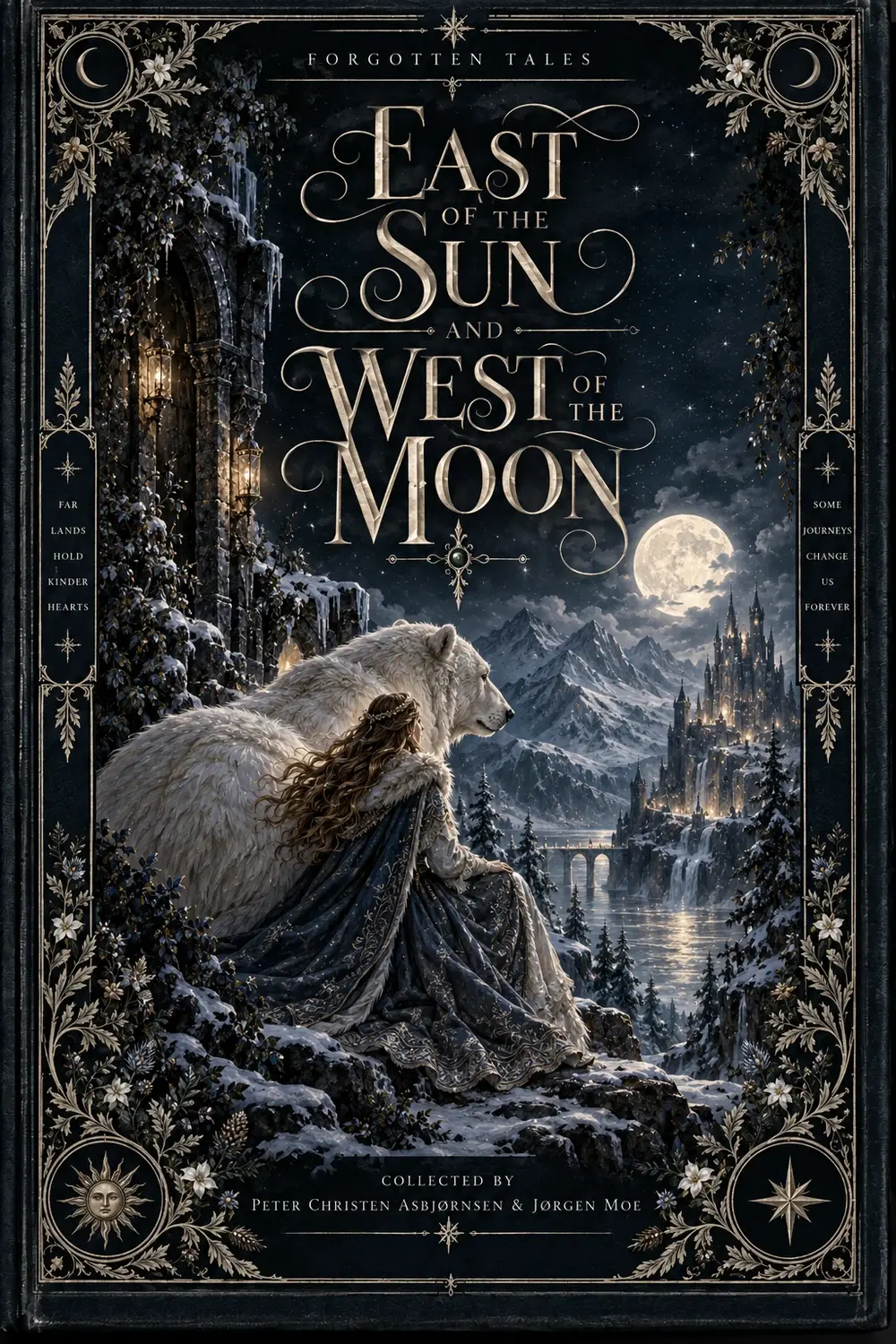
East of the Sun and West of the Moon
Norway · ATU 425A
A Fabula Tenebris Edition
14 minute read
Once there lived a poor farmer who had so many children that his house was always full and his table never quite enough.
His sons and daughters were all beautiful, but the youngest girl was lovelier than any of them.
One autumn evening, late in the year, a storm came down over the countryside.
Rain struck the roof.
Wind pressed against the walls.
The family sat close around the fire when three heavy knocks sounded against the window.
The farmer went outside.
There, in the darkness, stood an enormous White Bear.
“Good evening,” said the Bear.
The farmer answered him cautiously.
The Bear looked toward the house.
“Will you give me your youngest daughter?”
The farmer stared.
“If you do,” said the Bear, “I will make you as rich as you are now poor.”
The farmer thought immediately of the cold rooms, the worn clothing, the empty cupboards.
But he would not agree without asking his daughter.
He returned inside and told her what the Bear had said.
“No,” she answered.
Nothing could change her mind.
So the farmer went outside again and asked the Bear to return the following Thursday.
During the week, he spoke often to his daughter.
He told her how different all their lives might become.
He told her that she herself would want for nothing.
Little by little, her refusal weakened.
At last, she agreed.
She washed her clothes, mended what she could, tied her few possessions into a bundle, and waited.
The next Thursday, the White Bear returned.
The girl climbed onto his back.
He carried her away into the night.
After they had travelled for a long while, the Bear asked:
“Are you afraid?”
“No.”
“Then hold tightly to my fur, and nothing will harm you.”
So she did.
They travelled farther than she could measure.
At last they came to a great mountain of stone.
The Bear struck the cliff.
A door opened.
Inside was a castle.
Its rooms glittered with silver and gold.
Tables stood already prepared.
Lamps burned though no servants could be seen.
The Bear gave the girl a small silver bell.
“If you want anything, ring this.”
She rang it.
Food appeared.
Later, when she grew tired, she rang again.
A beautiful bedchamber was prepared for her, with white linen, silk pillows, and curtains trimmed in gold.
She lay down.
The lights went out.
In the darkness, someone entered the room.
A man lay beside her.
She could not see his face.
Before dawn, he left.
The same thing happened the next night.
And the next.
By day, she saw only the White Bear.
By night, a man came to her after the light was extinguished and disappeared before morning.
She never saw him.
For a time, she was content.
Then loneliness began to settle over her.
She missed her father.
She missed her mother.
She missed the noise of her brothers and sisters.
One day, the White Bear asked why she had grown so quiet.
She told him.
The Bear listened.
“You may visit them,” he said. “But promise me one thing.”
“What?”
“Do not speak with your mother alone.”
The girl frowned.
“Why?”
“She will try to draw you away from the others and speak privately. Do not let her. If you do, misfortune will come to both of us.”
The girl promised.
The Bear carried her home.
But the poor cottage she remembered was gone.
In its place stood a fine house.
Her brothers and sisters played outside in good clothing.
There was food.
There was warmth.
Everything the Bear had promised had come true.
Her family welcomed her with enormous joy.
They asked about her life.
She told them that she was well cared for.
She told them that she wanted for nothing.
But she did not tell them everything.
Her mother watched her closely.
Later that day, she tried to lead her daughter into another room.
The girl remembered the Bear's warning.
“Whatever we have to say, we can say here.”
Her mother tried again.
Still the girl refused.
But mothers can be persistent.
At last, the girl gave in.
Behind a closed door, she told her everything.
She told her mother about the strange castle.
About the White Bear.
About the man who came every night after darkness fell.
About how she had never once seen his face.
Her mother's expression changed.
“What if he is a troll?”
The girl said nothing.
Her mother took out a small piece of candle.
“Take this with you.”
She placed it in her daughter's hand.
“When he is asleep, light it. Look at him.”
The girl hesitated.
“But be careful,” her mother said. “Do not let the wax fall on him.”
That evening, the White Bear came to take her back.
After they had travelled some distance, he asked:
“Did everything happen as I warned you?”
The girl could not deny it.
The Bear grew quiet.
“If you listened to your mother's advice,” he said, “you may bring sorrow upon us both.”
The girl insisted that everything would be fine.
But the candle was hidden beneath her clothes.
That night, the man came as always.
He lay beside her.
She waited until his breathing became deep and slow.
Then she rose.
She lit the candle.
And for the first time, she saw him.
He was not a troll.
He was a young prince.
So beautiful that for a moment she could scarcely breathe.
She stood beside him, holding the candle, staring at the face that had been hidden from her for so long.
And the more she looked, the more she loved him.
Unable to resist, she bent down to kiss him.
As she did, three drops of hot tallow fell from the candle onto his shirt.
The prince awoke.
He saw the light.
He saw the candle.
And his face filled with despair.
“What have you done?”
The girl dropped the candle.
The prince sat up.
“If you had only waited one year, I would have been free.”
She stared at him.
He told her the truth.
His stepmother had enchanted him.
By day, he was forced to wear the shape of a White Bear.
Only at night could he return to his human form.
If the girl had lived beside him for one full year without looking upon him, the spell would have broken.
But now the enchantment had changed.
“I must leave you,” he said.
“No.”
“I must go back to my stepmother.”
The girl began to cry.
“And where does she live?”
“In a castle east of the sun and west of the moon.”
He lowered his eyes.
“There is a princess there, with a nose three yards long. Now I am bound to marry her.”
The girl held onto him.
“Take me with you.”
“I cannot.”
“Then tell me the road.”
“There is no road.”
He looked at her sadly.
“The place lies east of the sun and west of the moon. You will never find it.”
In the morning, she awoke alone.
The castle was gone.
The prince was gone.
She lay on a small patch of grass in the middle of a dark forest.
Beside her was the same little bundle of worn clothes she had brought from home.
For a long time she cried.
Then she stood.
And began to walk.
She travelled for many days until she reached a high cliff.
Beneath it sat an old woman playing with a golden apple.
The girl asked whether she knew the way to the castle east of the sun and west of the moon.
The old woman studied her.
“Are you the girl who was meant to have the prince?”
“Yes.”
The old woman shook her head.
“I know of the place, but not the way there.”
The girl looked down.
“You may take my horse,” said the woman. “Ride to my neighbour. Perhaps she knows more.”
Before the girl left, the old woman gave her the golden apple.
“You may find a use for this.”
The girl rode until she came to another high cliff.
There sat another old woman.
In her hands was a golden carding comb.
Again the girl asked for the castle east of the sun and west of the moon.
Again the answer was the same.
“I know of it. I do not know the road.”
The second old woman sent her onward to a third.
And she gave the girl the golden comb.
At the third cliff sat another old woman, spinning with a golden spinning wheel.
“Are you the one who should have had the prince?” she asked.
“Yes.”
The old woman sighed.
“I do not know the way either.”
Then she pointed toward the horizon.
“But perhaps the East Wind does.”
She lent the girl another horse and gave her the golden spinning wheel.
So the girl continued.
At last she reached the house of the East Wind.
“Do you know the castle east of the sun and west of the moon?”
The East Wind shook himself.
“I have heard of it.”
Hope rose in the girl's heart.
“But I have never blown so far.”
Her hope fell again.
“Still,” said the East Wind, “my brother the West Wind is stronger than I am. Perhaps he knows.”
“Will you take me to him?”
“Climb onto my back.”
The girl did.
The East Wind rose.
They flew over valleys and forests until they reached the West Wind.
But the West Wind did not know the road either.
“I have never travelled that far.”
He thought for a moment.
“Perhaps the South Wind has.”
So the West Wind carried her onward.
The South Wind had crossed many countries and seas.
But even he had never reached the castle.
“There is only one left to ask,” he said.
“The North Wind.”
The girl climbed onto his back.
They travelled until the air grew bitterly cold.
Before they even reached his house, the North Wind roared at them.
“What do you want?”
The South Wind answered:
“This is the girl who should have had the prince in the castle east of the sun and west of the moon.”
The North Wind became still.
“I know that place.”
The girl stepped forward.
“Can you take me there?”
The North Wind looked at her for a long moment.
“Once, I blew an aspen leaf there.”
“That is enough. You know the way.”
“I was exhausted for days afterward.”
“I must go.”
“You may not survive the journey.”
“I must go.”
The North Wind saw that nothing would change her mind.
“Then sleep here tonight. We will need the whole day.”
At dawn, the North Wind grew enormous.
He drew air into himself until he seemed to fill the sky.
The girl climbed onto his back.
Then they flew.
They passed above mountains.
They crossed forests.
Far below them, trees bent beneath the storm.
They reached the sea.
Still the North Wind flew.
The farther they travelled, the weaker he became.
His great gusts became smaller.
His breath came harder.
They dropped lower and lower until the waves almost touched them.
“Are you afraid?” asked the North Wind.
“No.”
So he continued.
At last, land appeared.
With the final strength left in him, the North Wind carried her to the shore beneath the windows of a great castle.
Then he collapsed to rest.
The girl looked upward.
She had found it.
The castle east of the sun and west of the moon.
The next morning, she sat beneath the castle windows and played with the golden apple.
A princess appeared above.
Her nose was extraordinarily long.
The girl knew immediately who she was.
“What do you want for that golden apple?” called the princess.
“It is not for sale.”
“I can give you gold.”
“I do not want gold.”
“Then name your price.”
The girl looked up.
“Let me spend one night with the prince.”
The princess smiled.
“That can be arranged.”
She took the apple.
That evening, the girl was led into the prince's chamber.
He lay asleep.
She called his name.
Nothing.
She shook him.
Nothing.
She wept beside him.
Still he would not wake.
At dawn, the long-nosed princess came and drove her away.
The second day, the girl sat beneath the window with the golden carding comb.
Again the princess appeared.
Again she wanted the golden object.
Again the price was one night with the prince.
And again, when the girl entered his room, he slept so deeply that no voice or touch could reach him.
She cried until morning.
Then she was driven out.
On the third day, the girl brought out the golden spinning wheel.
The princess wanted it at once.
“One more night,” said the girl.
“Agreed.”
But by then, something had changed.
There were captives in the castle who slept near the prince's room.
For two nights they had heard a woman crying and calling to him.
They told the prince.
And the prince understood.
That evening, when the troll princess brought him his usual drink, he pretended to swallow it.
But he poured it away.
When the girl entered his room that night, his eyes were open.
For a moment neither of them spoke.
Then she ran to him.
She told him everything.
The three old women.
The golden apple.
The comb.
The spinning wheel.
The winds.
The sea.
The North Wind.
All of it.
The prince listened.
“You came.”
“Of course I came.”
He held her.
“You arrived just in time. Tomorrow is to be my wedding.”
The girl went pale.
“But there may still be a way.”
He showed her the shirt marked by the three drops of candle tallow.
“I will say that I will marry only the woman who can wash these stains away.”
The girl looked at him.
“The trolls cannot do it.”
“And I can?”
“You made the stains.”
He smiled.
“You are the only one who can remove them.”
The next morning, preparations for the wedding began.
Before the ceremony, the prince spoke.
“I want to know whether my future wife is capable of caring for what belongs to me.”
The troll stepmother laughed.
“What must she do?”
The prince held up his shirt.
“Three drops of tallow have stained this. I will marry only the woman who can wash it clean.”
The long-nosed princess took the shirt.
She scrubbed.
The stains grew darker.
She scrubbed harder.
The marks spread.
The troll stepmother snatched the shirt from her.
“You do not know how to wash.”
She tried.
The shirt grew uglier.
Other trolls came.
One after another, they rubbed, twisted, soaked, and scrubbed.
The more they worked, the darker the cloth became.
At last, the shirt looked as though it had been dragged through soot.
The prince shook his head.
“None of you can do it.”
Then he looked toward the girl outside.
“What about her?”
The trolls laughed.
“A beggar girl?”
“Let her try.”
She stepped forward.
The prince handed her the shirt.
“Can you wash it clean?”
She touched the cloth.
“I think I can.”
She dipped it into the water.
Almost at once, the darkness vanished.
The cloth became white.
Whiter still.
The three stains disappeared completely.
The prince smiled.
“This is the woman I will marry.”
The troll princess screamed.
Her mother flew into such a rage that the whole castle seemed to shake.
And then, as old tales sometimes tell it, their fury destroyed them.
The troll princess vanished.
The stepmother vanished.
The other trolls scattered or perished with them.
The enchantment was broken.
The prince was free.
The prince and the girl opened the prisons of the castle and released everyone who had been held there.
They gathered what silver and gold they could carry.
Then they left the place.
They travelled far away.
Far from the trolls.
Far from the castle.
Far from the place that lay east of the sun and west of the moon.
And this time, when they went together, neither enchantment nor darkness separated them again.
The end.
About this edition
East of the Sun and West of the Moon is a Norwegian folktale collected by Peter Christen Asbjørnsen and Jørgen Moe and first published in their Norske Folkeeventyr in 1844. It belongs to the international tale family ATU 425A, “The Search for the Lost Husband,” a broad family of stories involving an enchanted or hidden bridegroom and a long journey undertaken to recover him. (Impression Editions)
This Fabula Tenebris edition follows the traditional Asbjørnsen–Moe narrative and was checked against public-domain English translation traditions associated with George Webbe Dasent and the nineteenth-century collections in which the story circulated in English. Wikisource records both an 1889 translation in Andrew Lang's The Blue Fairy Book and a Dasent lineage of the tale, while Project Gutenberg preserves a later illustrated collection drawing on those older translations. (Project Gutenberg)
Historical editions & further reading
These historical editions are offered for comparison and further reading. The supplied Fabula Tenebris edition above is not presented as a verbatim transcription of these sources.
East of the Sun and West of the Moon — The Blue Fairy Book — An English version in Andrew Lang’s 1889 collection; a comparison edition, not an attribution of our wording.