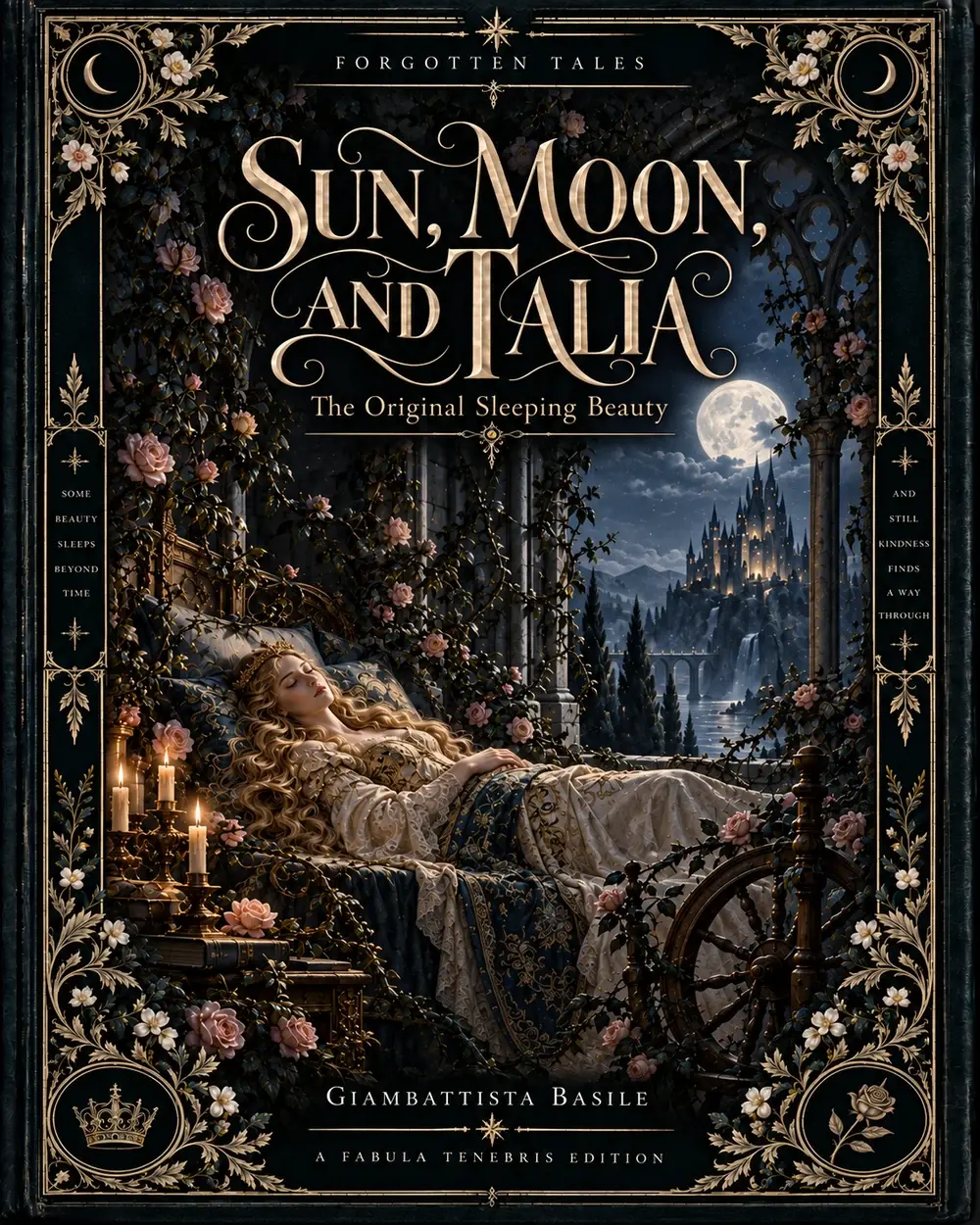
Sun, Moon, and Talia
Italy · The Pentamerone · Literary Fairy Tale
A Fabula Tenebris Edition
9 minute read
There was once a great lord whose daughter was named Talia.
When she was born, her father summoned every wise man, astrologer, and seer he could find.
He wanted to know what kind of life awaited his child.
The men studied the stars.
They calculated.
They argued among themselves.
At last, they agreed upon one thing.
A terrible danger would come to Talia through a piece of flax.
Her father was horrified.
He immediately commanded that no flax, hemp, spindle, or anything connected with spinning should ever enter his house.
Servants searched the rooms.
Anything that might carry the danger was removed.
Talia grew.
She became a beautiful young woman.
And for many years, the prophecy seemed to have been defeated.
One afternoon, Talia stood beside a window.
Far below, an old woman passed along the road.
The woman was spinning.
Talia had never seen such a thing.
She watched the spindle turning between the woman's hands.
Curiosity overcame her.
She called down.
“Come inside.”
The old woman obeyed.
Talia examined the strange tools.
“What are you doing?”
“Spinning flax.”
Talia reached for it.
She wanted to understand how such a simple thing could become thread.
The old woman showed her.
Talia took the flax into her own hands.
Then a tiny splinter slipped beneath her fingernail.
At once, she fell to the floor.
The old woman cried out.
Servants came running.
But nothing woke Talia.
Her father sent for physicians.
He sent for wise men.
He offered gold.
He begged.
Nothing helped.
Talia did not breathe as the living breathed.
Yet she did not decay.
She seemed caught somewhere between sleep and death.
Her father could not bear to bury her.
So he carried her to one of his country houses.
It stood alone in a distant place.
There he placed Talia upon a bed beneath a canopy.
He closed the doors.
Then he left.
He never returned.
Time passed.
One day, a king was hunting in the surrounding country.
His falcon escaped from him and flew toward the abandoned house.
The bird entered through one of the windows.
The king followed.
He knocked at the door.
No one answered.
He called.
Nothing.
At last, he found a way inside.
The rooms were silent.
Dust lay upon the furniture.
No servants walked the corridors.
No fire burned.
Then he entered the chamber where Talia lay.
He stopped.
She looked alive.
Her face still held its color.
Her body had not changed.
The king called to her.
Talia did not answer.
He touched her.
She did not wake.
And there, while she remained unconscious and unable to consent, the king violated her.
Afterward, he left the house and returned to his kingdom.
Talia remained asleep.
She never knew he had been there.
Months passed.
Still Talia did not wake.
But while she slept, her body changed.
At last, without ever opening her eyes, she gave birth to two children.
One boy.
One girl.
The infants were beautiful.
No mother woke to hold them.
No servants came.
But fairies appeared and cared for them.
They carried the children to Talia when they were hungry.
The babies searched for milk.
One day, one of them could not find his mother's breast.
Instead, he took one of her fingers into his mouth.
He sucked upon it.
And the tiny splinter of flax beneath her fingernail came free.
Talia opened her eyes.
She stared upward.
The room was unfamiliar for a moment.
Then she saw the children beside her.
She sat up.
She remembered standing at the window.
She remembered the old woman.
The spindle.
The sudden pain beneath her fingernail.
Nothing after that.
Yet now there were two infants lying beside her.
Talia did not understand.
She called for help.
No one answered.
Still, food and drink appeared within the house.
The unseen beings who had cared for the children continued caring for her.
Talia named the babies.
The boy she called Sun.
The girl she called Moon.
And though she did not understand how they had come into the world, she loved them.
Some time later, the king remembered the strange sleeping woman he had found during the hunt.
He returned to the abandoned house.
This time, when he entered the chamber, Talia was awake.
Two children played beside her.
The king stood speechless.
Then he told her who he was.
And what had happened.
Talia learned at last why Sun and Moon existed.
The king remained with her for several days.
Before leaving, he promised that he would return.
Back in his own kingdom, he could think of little else.
At meals he spoke the names:
“Talia.”
“Sun.”
“Moon.”
At night, he murmured them in his sleep.
Again.
And again.
But the king already had a wife.
And she heard him.
The queen became suspicious.
Who was Talia?
Who were Sun and Moon?
She summoned the king's secretary.
“Tell me.”
The secretary hesitated.
The queen promised him riches if he spoke.
And ruin if he refused.
Fear and greed defeated loyalty.
He told her everything.
The abandoned house.
Talia.
The children.
The king's visits.
The queen listened.
Her anger grew colder with every word.
Then she formed a plan.
She sent a message to Talia in the king's name.
The king, the message claimed, wished to see his children.
Sun and Moon were to be sent to the palace.
Talia trusted him.
She kissed the children and sent them away.
The queen received them.
She looked at their faces.
She saw the king in them.
And hatred filled her.
She summoned the royal cook.
“Take these children.”
The cook looked down at Sun and Moon.
“They are to be prepared for the king.”
He stared at the queen.
She did not smile.
“You will cook them.”
The cook went pale.
The children looked up at him.
They were too young to understand.
“Your Majesty...”
“Do as I command.”
The cook bowed.
He took Sun and Moon away.
But the cook could not do it.
He had killed animals.
He had prepared countless feasts.
He had obeyed kings and queens all his life.
But he would not murder two children.
He brought Sun and Moon secretly to his wife.
“Hide them.”
She saw his face.
“What has happened?”
“Do not ask now.”
Together they concealed the children.
Then the cook prepared two young animals in their place.
He seasoned the meat carefully.
He made several dishes.
That evening, the king sat down to eat.
The queen sat across from him.
The dishes were brought.
The king ate.
The queen watched.
With every mouthful, she smiled.
“Eat,” she said.
The king continued.
“Eat.”
He looked at her strangely.
“What is wrong with you tonight?”
The queen leaned toward him.
“You are eating what is your own.”
The king did not understand.
She repeated it.
“Eat.”
“You are eating what belongs to you.”
He assumed she meant that everything served at his table belonged to him.
So he laughed.
“Of course it is mine. You brought nothing into this house.”
The queen's smile disappeared.
She said nothing more.
But her anger had not been satisfied.
The children were not enough.
She wanted Talia.
Again, she sent a message in the king's name.
This time, Talia herself was summoned to the palace.
Talia was delighted.
She believed the king wished to see her.
She dressed carefully.
Then she travelled to him.
But when she entered the palace, the queen was waiting.
Talia stopped.
She had never seen the woman before.
The queen looked at her from head to foot.
“So.”
“You are Talia.”
Talia understood at once that something was wrong.
The queen's face twisted with rage.
“You are the woman who has stolen my husband.”
Talia tried to speak.
The queen would not listen.
She accused her.
Insulted her.
Then she ordered servants to build a great fire in the courtyard.
Wood was piled high.
Flames rose.
Heat filled the air.
The queen pointed toward it.
“You will burn.”
Talia stared at the fire.
She begged for mercy.
None came.
At last, she asked for one small kindness.
“If I must die, allow me to remove my clothing first.”
The queen looked at Talia's rich garments.
She wanted them for herself.
So she agreed.
Talia removed one garment.
Then another.
And with each piece she took off, she cried out.
Not from modesty.
Not from fear.
But as loudly as she could.
Again.
And again.
Her cries travelled through the palace.
The king heard them.
He came running.
He entered the courtyard and saw the flames.
He saw Talia.
He saw his wife.
“What is happening?”
The queen turned toward him.
Her anger became triumph.
She told him everything.
She had discovered his secret.
She had brought his children to the palace.
She had ordered them cooked.
And the king, she told him, had eaten them himself.
For a moment he could not speak.
Then something terrible came over his face.
“My children?”
The queen smiled.
“Sun and Moon.”
The king staggered.
He believed her.
He called her a monster.
Then he turned on the secretary who had betrayed him.
He called for the cook.
“Bring him to me.”
The cook appeared.
The king looked at him with horror.
“You obeyed her?”
The cook fell to his knees.
“No, Your Majesty.”
The king stopped.
The cook called for his wife.
She entered the courtyard.
And with her came two children.
Sun.
Moon.
Alive.
They ran toward their father.
The king fell to his knees and gathered them into his arms.
He kissed one.
Then the other.
Then Talia.
For a long moment, nothing else existed.
Then the king rose.
He looked toward his wife.
The fire she had prepared was still burning.
The queen tried to speak.
The king would not hear her.
The punishment she had intended for Talia became her own.
She was condemned to the flames.
The secretary who had betrayed the king was punished with her.
The cook, however, was rewarded.
The king embraced him.
“You saved my children.”
He raised the cook above his former station and gave him wealth and honor.
Sun and Moon remained with their parents.
And Talia, who had once fallen beneath a prophecy she could not escape, became queen.
She lived with the king and her children for many years.
The old tale ends by saying that some people are fortunate even while they sleep.
But Talia had learned something stranger than fortune.
A thread had cast her into darkness.
A child had drawn it out.
She had awakened in a world she did not understand.
And still, somehow,
the sun had found her.
And the moon had remained beside her.
The end.
About this edition
Sun, Moon, and Talia is a literary fairy tale by the Neapolitan writer Giambattista Basile. It appears in his seventeenth-century collection Lo cunto de li cunti, later widely known as The Pentamerone, which was published posthumously beginning in 1634. The story is one of the most famous early literary relatives of what later became the Sleeping Beauty tradition. (Project Gutenberg)
This Fabula Tenebris edition follows Basile's narrative closely: the prophecy involving flax; Talia's enchanted unconscious state; the king finding her while she cannot awaken; the birth of Sun and Moon; the child drawing the flax splinter from her finger; the jealous queen's attempt to have the children cooked and served to their father; the cook secretly saving them; and the queen preparing a fire for Talia before her plan is exposed. Basile's original tale includes sexual violence against the unconscious Talia, an element often removed entirely from later Sleeping Beauty adaptations. (Project Gutenberg)
The edition was checked against public-domain English versions of The Pentamerone, including the nineteenth-century translation preserved by Wikisource and the public-domain text available through Project Gutenberg. (Wikisource)
The historical tale & its ending
Is Sun, Moon, and Talia the original Sleeping Beauty?
It is an early literary relative of Sleeping Beauty, written by Giambattista Basile and published in his seventeenth-century Pentamerone. Calling it “the original” is useful shorthand but can obscure the tale’s wider history. This page offers a modern English retelling, with a historical version linked below.
How does Talia wake up, and why is this version disturbing?
One of her children sucks the flax splinter from her finger, ending her enchanted sleep. Before that awakening, a king sexually assaults her while she is unconscious. A queen later threatens Talia and her children. These are serious elements of the tale, not a romantic rescue.
Historical editions & further reading
These historical editions are offered for comparison and further reading. The supplied Fabula Tenebris edition above is not presented as a verbatim transcription of these sources.
Sun, Moon, and Talia — Stories from the Pentamerone — A historical English version of Basile’s collection for comparison.